

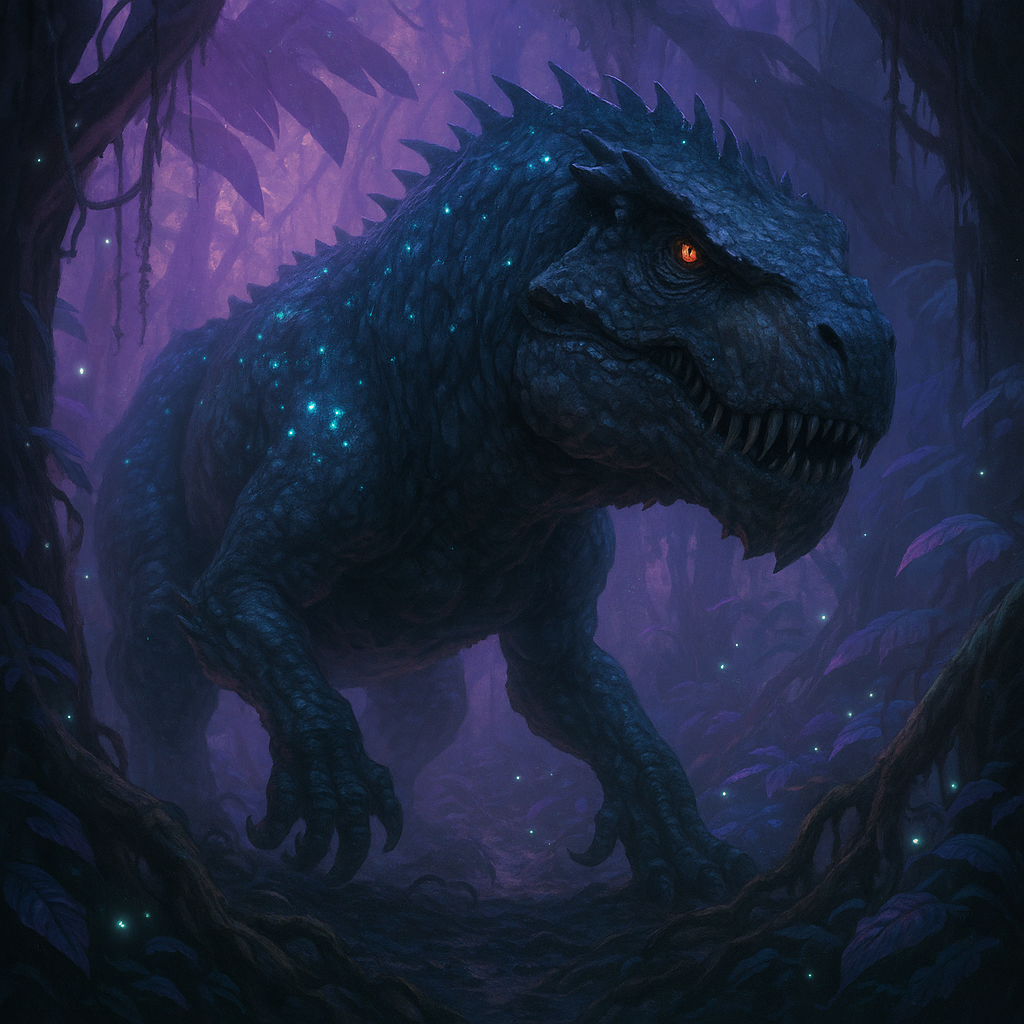
Light bled through the almost translucent violet leaves, turning the jungle into a cathedral of glass and shadow. The air was thick enough to taste—damp, metallic, alive.
Veya Damaris had read about this world, but the reports hadn’t captured the way the air pressed close against her lungs, or how every branch looked too deliberate in its twisting to be random. Spores floated in lazy spirals, glowing softly as they clung to the vines. Veya shifted her stance, every step sinking an inch into the loam.
The jungle was not silent. Leaves whispered overhead, mingling with the chorus of unseen insects buzzing in uneven rhythms, answered by a distant croak of something hidden in the undergrowth several yards away.
The sights, the sounds, the beauty of it all almost distracted her from the mission at hand, until she caught sight of the glowing military-grade crate several feet away, tucked at the foot of a large tree trunk. She knew that was the supply crate abandoned by an earlier crew due to predator activity in the area. She was to retrieve it and bring back safely to the extraction point for transport.
Sounded easy enough at the time when she was being briefed, but now that her vision panned to the right and she saw the crate was sitting very close a large nest with eggs the size of her height and three times her width, she realized the extraction was in fact a pretty tall order.
A low rumble rolled through the ground beneath her boots. She froze. Her pulse quickened when the trees in front of her swayed, not from wind, but from something massive moving between them. She held her breath.
Arden’s voice echoed in her memory, “Hey, remember to breathe. Then, listen. Lastly, when the time is right—act.”
She drew a breath and strained to hear beyond the pounding of her own blood. Leaves crackled. A branch snapped. Then came the low growl—deep, resounding, a predator’s warning.
The canopy above shifted and shape emerged between the trunks—larger than a transport crawler, its outline blurred by a sheen of phosphorescent spores clinging to its hide. Its nostrils flared as it swept the undergrowth, each breath rattling the leaves.
Veya forced her hand to stay off her weapon. It was far enough away to hopefully not be able to smell her yet. If it instead hunted by movement, to move too soon would be to announce herself. She wasn’t familiar with this species to know which sense it relied on.
She knew she would face Unknowns and she knew she had to figure out its behavior now. How did it hunt its prey? Through scent or movement or sound? Or, keeping in line with her luck as of late—all of the above?
It took a couple steps closer. The ground quaked with each step, and the air thickened with a sharp tang of ozone. She knew that’s what it would smell like whenever a creature of this planet appeared, a strange but useless fact to recall at this moment, while all other thoughts—say about behavioral cues of Thalyss’ apex predators—have abandoned her. Unfortunate, because those would’ve been helpful.
Her hand loomed over her weapon but to risk moving now might draw the creature’s attention to her. Not that it would matter anyway, she was only equipped with a DART which was only effective against medium-sized creatures, not apex predators. Why would they arm her with this when they knew it would be insufficient? She did not have the time to think further of it. It took several steps closer to her location.
She entered into a debate with herself of whether to move, which might draw the creature’s attention to her, or stay still and hope it changed directions. Veya’s heart pumped frantically in her chest as her mind raced between the two options. Choose wrong and there would be no coming back. Choose right and…she would be one step closer to finding her brother. This seemed to give her the strength she needed to clear her head.
Which was great because a sudden rush of wind blew from behind her straight into the direction of the animal in front of her. Almost as if it was orchestrated. She bit back a curse, held her breath and watched carefully. The creature took a steadying step forward, but there was no other visible reaction to her scent being carried straight to it.
That still left sound and movement. But she couldn’t test sound without initiating movement. Unless…her eyes widened in recollection and she silently thanked God for her experiences back on the colony.
Her throat mic rested against her collar. Fifty meters behind her, buried under the roots of a fallen tree, the sonic charge she’d planted earlier waited.
“Trigger beacon one,” she whispered.
A sharp crack echoed through the jungle. Birds erupted from the canopy. Something small shrieked and fled through the brush.
The beast’s head turned towards where the sound retreated and waited. Muscles coiled, watching. It wasn’t motivated to chase. If it hunted by sound, it would’ve been confident in it’s ability to track to give chase.
Damn. That meant it hunted by movement. With smell or sound she had a chance. She could have stayed downwind. She could have created artificial noise to distract. Movement was harder to keep undetected from an animal only 20 feet from you.
Its eyes surveyed the ground and took another step forward. The vines around her started glowing more fiercely as if mirroring her panicked state. The creature might not have noticed her yet, but it was getting closer to her, effectively shortlisting her already short list of options. If she waited any longer to make her escape, she would not have enough of a head start to actually outrun it.
She decided to test its visual scope by easing a foot back. The creature’s head snapped toward her. Wrong move. The glow in its eyes flared. Very wrong move. Its body tensed, weight shifted, muscles bunched for the strike. Extremely wrong move.
Veya turned and ran into the thicket of trees on her left. She heard a heard large mass collide with the trees and rocks behind her. She turned back and aimed her DART at the creature that was now momentarily off balance. Looking through the crosshair, she focused on its eyes. She set the gun to film and fired. Direct hit. The creature roared and shook its head. A slight film covered its left eye, she knew it was blurring its vision. But it was not enough.
She sprinted across its path, skidding low as it thrashed, and came out on its other side. She looked up, aimed and was close enough to see its other eye dilate before her second shot of film covered it as well. Its roar was more terrible than the last.
Both eyes clouded, a milky film spreading across them. It bellowed blindly, thrashing at trees. Veya didn’t wait. She made a beeline for the crate, lungs burning, praying its mate was not nearby and hadn’t heard its calls.
As soon as she reached it, she shot her flare into the sky. Her mission was to carry the crate to the transport bay, but she knew she would not be able to make it the traditional way. She quickly shrugged off her pack, lifted the areal board out and placed the crate on top.
Her head snapped when she heard a similar roar as the creature behind her. Except it was from a different direction and by the sound of it, not too far away.
She hoisted her pack back on her shoulders, stepped on to the board making sure to straddle the crate to keep it as secure as possible, and looked up to scan for openings in the canopy. Then looked down at the screen on her armband and pressed a finger. The board activated and quickly gained altitude. She looked up again, keeping her finger on the screen and moving it to change directions to circumvent branches.
She looked back down when another one of the predators became visible. She glanced with sadness at the creature she left struggling, its growls sounding more pained. While she knew the film on its eyes was not hurting it, she could only imagine what not being able to see for an animal that relied on its vision to survive must feel like. It would be a temporary condition, but it did not know that. But at least its mate was with it now.
She cleared the canopy and looked around, then laughed with relief when she saw the Labrador flying towards her, its sharp dark angles and bulky build brought in a rush of relief.
It was only a few feet away when she heard the call of a Quetzalcoatlus. She turned to look—and the sky split open in a shriek. A sort of halo surrounded her as the Quetzalcoatlus rose from below, its beak longer than she was tall, blotting out everything. And then—frozen.
Veya exhaled as it dissolved, breaking apart into shards of light. The humid air vanished, replaced by the sterile chill of the simulation chamber. White walls replaced the red sky, stretching around her, smooth and seamless. The faint hum of tech swallowed the silence. Sweat clung to her brow, her clothes damp.
She pushed her shoulders back, and attempted to get her breathing under control, refusing to let the evaluators watching from behind the glass see how much the simulation had affected her. Even though she knew her vitals were being monitored and they could easily see the impact based on the readings, she still felt obligated to present a façade of calm.
“Damaris, before we give you your result, would you like to comment?”
Still breathing heavily, she shook her head stiffly. Then, when they did not continue, she added. “No.”
A different voice inquired. “Why did you use the DART’s film setting?”
She blinked. “The DART is not designed for Apex predators. It is only intended for short-range, non-lethal force designed to incapacitate wildlife without killing. It is also only effective against medium-sized creatures and was not fit for this mission.”
She hoped the last sentence was not as accusatory as she felt in her mind.
The evaluator nodded impatiently. “Yes, but why the film setting? Why not use the highest setting at its weakest points? The eyes were a good target, but would it not have been more effective to use a higher energy setting?”
This is what usually got her into trouble. Something as simple as compassion would destroy her chances of getting this, after everything she’s gone through to get to this point. She almost kicked herself for her stupidity.
“In the Biosphere program, one of our auxiliary mandates is to study wildlife to identify the advantages of their existence to our society. This was a predator I was unfamiliar with and was unaware of its uses and the possible benefit it could provide to our civilizations. In a real world scenario, causing permanent damage to a creature would hinder our ability to study it effectively, as was discovered in the case of Appenhome and the Shizplousaur. Appenhome had amputated the Shizplousaur’s leg in an act of self defense, not realizing that this would set us back several centuries in discovering the use of its front claw as a viable energy source. Because we still know so little about the Biosphere and its creatures, its imperative we keep them intact whenever possible as sightings and captures of valuable resources are rare.”
She did not know how she was able to formulate that response–must be the adrenaline– but she hoped it appealed to their lesser desires enough to be accepted.
Another voice spoke. “Do you believe you’ve completed the mission successfully?”
Veya stayed impassive. “Yes. I believe the simulation ended prematurely, if left to run longer, I would have made it back to the ARC with the abandoned crate.”
The amusement in the voice that responded was only slightly restrained. “And why do you believe you survived that last encounter?”
“The halo was already deployed. I would have been safely aboard the Labrador with the crate before the Quetzalcoatlus even began to close its beak.”
“But your mission was to get the crate to the transport bay.”
“The Labrador has the ability to fly to the transport bay, though if efficiency were your measure, returning straight to the ARC would have been the best option as that is the crate’s final destination. In either scenario, however, the crate would end up in the correct department for processing.”
Silence followed. Heavy. Intentional. Behind the glass, the shadows shifted. Notes were tapped onto their various individual screens. Someone exhaled, just loud enough for her to hear. Then–a voice cut in, cool and mechanical: “Candidate Veya Damaris. Evaluation complete. Admittance to Biosphere-ARC Program confirmed.”
She inclined her head, as if the verdict was expected. Only the sharp exhale through her nose betrayed the emotions she’d held at bay.
Breathe. Listen. Act. For the first time since the day she heard news of her brother’s disappearance, the words felt less like shackles and more like victory.

 Green Where You Water It
Leave a comment