
⚠️ HUGE SPOILERS AHEAD ⚠️
The post below covers the book in its entirety, revealing all mysteries and ending scene. If you haven’t read the book yet, you may want to pause on this post and come back after to recap.
Scene Spotlight
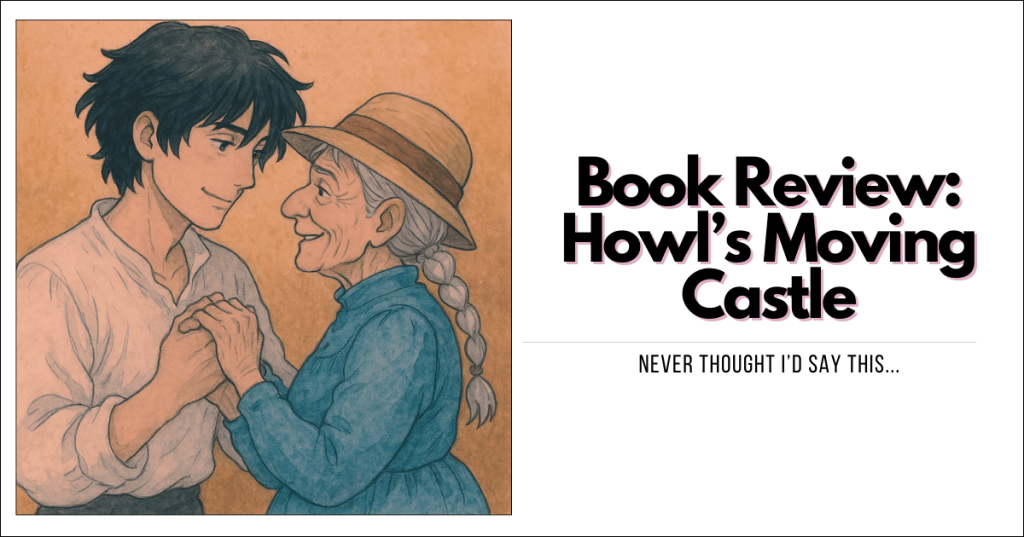
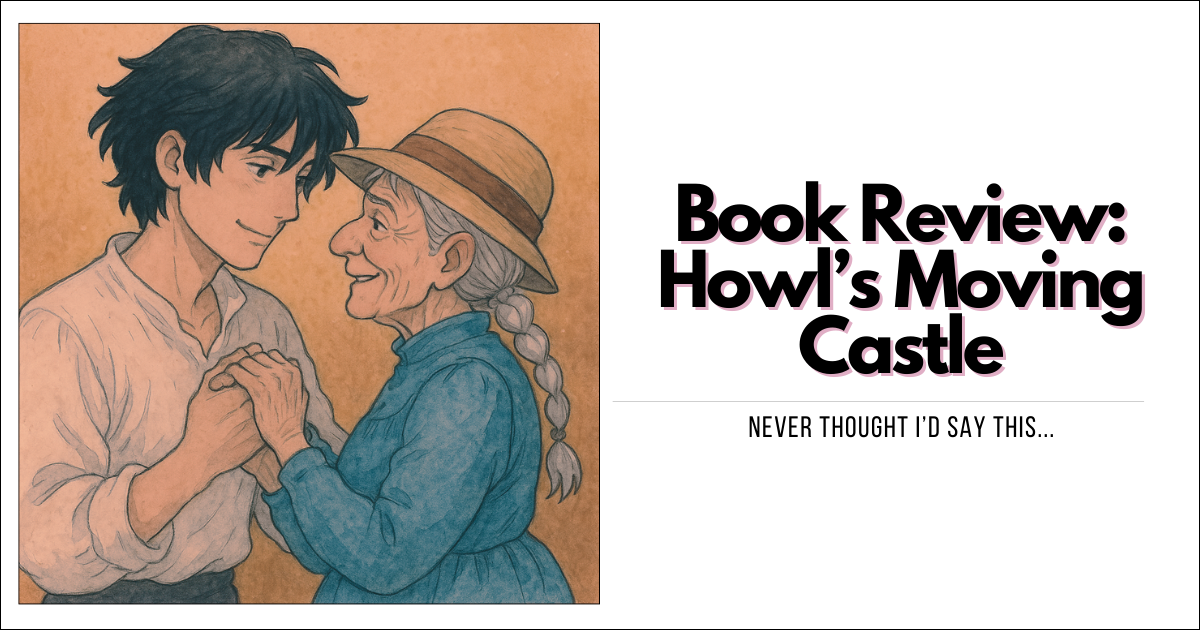
What makes a fantasy story unforgettable isn’t just the battles, curses, or enchanted castles—it’s the moment when the characters finally see each other as they truly are.
That’s exactly how Howl’s Moving Castle closes. The final scene between Sophie and Howl isn’t about magic or danger, but about honesty, banter, and the promise of a messy, mischievous love.
(Note: Wherever “…” is indicated, I’ve omitted text for brevity. Square brackets indicate paraphrasing or added detail to give context.)
…Howl turned to Sophie just then. “Grey [hair] doesn’t really suit you, he said. “I thought that when I first saw you.”
”Calcifer’s gone,” Sophie said. “I had to break your contract.”
Howl looked a little sad, but he said, “We were both hoping you would. Neither of us wanted to end up like the Witch and Miss Angorian. Would you call your hair ginger?”
”Red gold,” Sophie said. “Unlike some people’s…it’s natural.”
”I’ve never seen why people put such value on things being natural,” Howl said, and Sophie knew then that he was scarcely changed at all.
…Howl said to Sophie, “I’ve been wondering all along if you would turn out to be that lovely girl I met on May Day. Why were you so scared then?”
[There is an exchange in the background in which Wizard Suliman’s earnest attempt to reconcile with Sophie’s sister, Lettie, makes Lettie blush and be at a loss for words.]
That seemed to Sophie to be Lettie’s problem. She had her own. Howl said, “I think we ought to live happily ever after,” and she thought he meant it.
…”It should be hair-raising,” added Howl.
”And you’ll exploit me,” Sophie said.
”And then you’ll cut up all my suits to teach me,” said Howl.
If Sophie or Howl had any attention to spare, they might have noticed that Prince Justin, Wizard Suliman and Mrs. Fairfax were all trying to speak to Howl, and that Fanny, Martha and Lettie were plucking at Sophie’s sleeves, while Michael was dragging at Howl’s jacket.
…But Sophie and Howl were holding one another’s hands and smiling and smiling, quite unable to stop. “Don’t bother me now,” said Howl. “I only did it for the money.”
Reading that ending made me smile. But here’s the thing: the reason I picked up Howl’s Moving Castle in the first place was because I had already fallen in love with the Studio Ghibli film. What I didn’t expect were the stark differences between the book and the movie—different villain arcs, different twists, even a different tone.
10 Key Moments – Book vs Movie
Book Moments
Here’s a clear 10-moment sequence for Howl’s Moving Castle (Diana Wynne Jones novel, not the Miyazaki film), tracing the key beats of Sophie’s journey:
1. Sophie meets the Witch of the Waste
Sophie, the eldest of three sisters, is resigned to a dull life running her stepmother’s hat shop. When she insults the wrong customer—the Witch of the Waste—she is cursed into the body of an old woman.
2. Sophie leaves home
Unable to explain her sudden transformation, Sophie sets out on her own. She decides she has nothing to lose and heads into the hills, where she encounters Howl’s infamous moving castle.
3. Sophie enters the castle and meets Calcifer
Inside the castle, Sophie meets Calcifer, the fire demon bound to Howl. He offers to break her curse if she can break the contract that ties him to Howl. Sophie, pretending to be a cleaning lady, settles into the castle.
4. Sophie meets Michael (Howl’s apprentice)
Michael, Howl’s young apprentice, accepts Sophie’s presence without question. Sophie takes over household duties, giving her unexpected confidence and agency.
5. Howl and Sophie’s uneasy relationship begins
Howl is dramatic, vain, and mysterious, but he tolerates Sophie. Their banter grows sharp but affectionate. Sophie slowly realizes Howl isn’t the evil wizard everyone fears.
6. Sophie’s hidden powers emerge
Sophie unknowingly talks life into objects—like sticks and hats—and influences magic through her words. This hints that she has magic of her own, though she doesn’t recognize it yet.
7. Howl confronts the Witch of the Waste
The Witch is revealed to be a powerful enemy, pursuing Howl because of his past and his magical heart. Howl’s evasions and vanity cover real fear, and Sophie sees a more vulnerable side of him.
8. Sophie learns the truth of Howl’s heart
Through Calcifer, she discovers that Howl gave his heart to the fire demon years ago, binding their fates together. This explains both his power and his recklessness.
9. Sophie breaks both curses
When the Witch captures Howl, Sophie’s courage and hidden magic allow her to shatter the curses—freeing herself from her old-woman spell, breaking Calcifer’s bond, and restoring Howl’s heart.
10. Resolution: love and freedom
With curses lifted, Sophie and Howl admit their love for each other. The moving castle, the contracts, and the disguises fall away, leaving both of them freer than before—Sophie from her self-doubt and Howl from his pact.
Movie Moments
Here’s a 10-moment sequence for Howl’s Moving Castle (Miyazaki film version), which differs a lot from Diana Wynne Jones’ book:
1. Sophie meets Howl
Sophie, a quiet hatmaker, is harassed by soldiers in the street when the mysterious wizard Howl rescues her. This encounter draws the attention of the Witch of the Waste.
2. The Witch of the Waste curses Sophie
Out of jealousy, the Witch places a curse on Sophie, turning her into an old woman overnight. Sophie decides to leave home to avoid questions and find a cure.
3. Sophie finds Howl’s castle
In the wilderness, Sophie meets a living scarecrow she calls Turnip Head, who leads her to Howl’s walking castle. Sophie enters and makes herself useful as a cleaning lady.
4. Meeting Calcifer and Markl
Inside the castle, Sophie encounters Calcifer, the fire demon who powers the castle, and Markl, Howl’s young apprentice. Calcifer hints that Sophie may be able to help him break his contract with Howl.
5. Howl’s transformations and vanity
Sophie sees Howl’s magical vanity firsthand—his obsession with his appearance, and his frightening transformations into a bird-like creature when he goes to fight in the war.
6. The King summons Howl
The war intensifies, and Howl is ordered to serve the king. The Witch of the Waste also answers the summons, and Sophie goes in Howl’s place to protect him.
7. The Witch stripped of her power
In the palace, the Witch of the Waste is magically stripped of her powers and becomes a harmless, pitiful old woman. Sophie begins to care for her despite their history.
8. Howl risks everything
Howl uses his magic recklessly to protect Sophie and those he loves, even as the war escalates. Each transformation into a bird-creature takes more of a toll on him.
9. Sophie’s vision of Howl’s past
Through Calcifer and a magical portal, Sophie sees Howl’s childhood—when he caught a falling star (Calcifer) and gave it his heart, binding them together. This explains both Howl’s power and his curse.
10. The curses are broken
With Sophie’s love and courage, she restores Howl’s heart, freeing Calcifer. The castle collapses but Turnip Head sacrifices himself to save them—revealed to be a prince under a curse. Sophie and Howl embrace a new future together, and the war comes to an end.
The Differences
The book and film share big themes (identity, courage, love, curses), but the film emphasizes anti-war messages and gives the Witch of the Waste a redemption, while the book leans into humor, Sophie’s hidden magic, and fairy-tale logic.
Diana Wynne Jones’ reflections on Miyazaki’s creative decision to weave war more obviously into a the storyline:
[Miyazaki] crammed the story full of flying machines and war scenes on the very thin basis that the King in my book was planning a war. Miyazaki and I were both children in World War II and we seem to have gone opposite ways in our reactions to it. I tend to leave the actual war out (we all know how horrible wars are), whereas Miyazaki (who feels just the same) has his cake and eats it, representing both the nastiness of a war and the exciting scenic effects of a big bombing raid. But the faint miffed feeling I had about this was very much smaller than the sheer awe I felt knowing that large numbers of people had spent several years painstakingly drawing and painting every frame in a long movie.
- – Diana Wynne Jones, Howl’s Moving Castle, from section at the end of the book titled: “Anime and Author”.
This makes it clear that while she noticed (and possibly disliked) the changes, she ultimately admired Miyazaki’s artistry.
Another Key Difference: Meandering
While Jones’ whimsical style is part of her charm, it can also feel like the plot meanders. Some examples:
- Sophie’s long stretches of cleaning and muttering: Much of the middle is Sophie scrubbing, grumbling, and talking life into objects. While it shows her growing influence, it can feel repetitive before the bigger plot threads resurface.
- Side characters’ subplots: We get detours into the lives of Martha and Lettie, and even Fanny, which expand the fairy-tale world but don’t always move Sophie’s central story forward.
- Howl’s vanity episodes: Scenes like the infamous green slime tantrum (when Sophie messes with his hair products) are funny but drawn out, slowing momentum during tense parts of the plot.
- Back-and-forth with the Witch and Miss Angorian: The Witch’s presence looms, then fades, then comes back in disguise. The Miss Angorian twist feels sudden, but the lead-up involves long stretches where the threat is more confusing than urgent.
- Shifting castle settings: The doors opening into different towns and spaces are a brilliant idea, but the narrative sometimes lingers on small errands or bits of gossip in each place instead of driving the main conflict.
My Take
While I admired Diana Wynne Jones’ imagination, I’ll admit something (that I never thought I would say): I liked the movie better. The film tightened the story, raised the stakes by focusing on the war themes, and gave the Witch of the Waste an unexpected redemption arc. And made the emotional arc more potent, leaving a lingering impression for years (which coincidentally was what led me to pick up the book). By contrast, the book often felt like it was unwinding slowly, with detours and tangents that didn’t always feel necessary. That said, the ending scene I shared above carried a charm that made finishing the book worthwhile.
Have you read it yet? What are your thoughts?



 Green Where You Water It
Leave a comment