
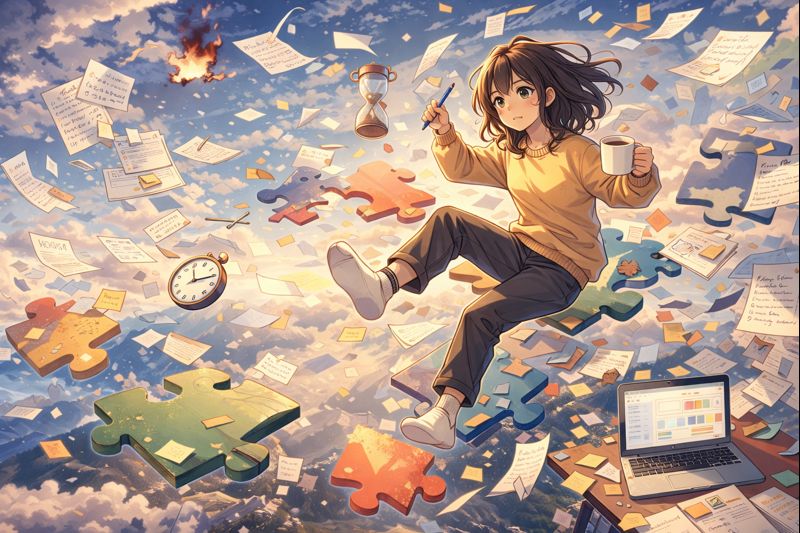
This is the first time I’ve written a story this way. With Biosphere, I’m not moving from beginning to end in a straight line. I’m writing scenes as they come to me—sometimes from the middle, sometimes from much later in the story, sometimes because a particular emotional moment refuses to leave me alone. It’s exciting, but it’s also unsettling. Without a linear path, I keep wondering how I’ll know when I’ve actually reached the finish line for the first draft.
When you write in order, finishing is obvious. You arrive at the end. Writing out of order removes that clarity. Instead of a clear endpoint, I’m left with a growing collection of scenes and fragments, each written at a different moment, carrying different levels of certainty. The question isn’t just when I’ll stop writing, but how I’ll recognize that what I have is enough to call a completed first draft.
Learning to Recognize the Finish Line
So…what even counts as ‘done’? The definition I keep coming back to is this:
A draft is done when it becomes whole, when the story’s promises are fulfilled.
If you’re a writer that writes out of order, there are a few points I imagine would signal a completed draft:
1. You stop discovering new story, and start connecting story
The more I write out of order, the more I’m starting to suspect that finishing this first draft won’t feel dramatic. It will probably feel more like a shift in the kind of questions you’re asking.
Early drafts are generative:
- new scenes
- new motives
- new secrets
- new consequences
At some point, something shifts.
You notice:
- You’re no longer inventing big moments
- You’re mostly stitching, clarifying, or deepening what already exists
- New ideas feel like variations, not revelations
That’s a reliable sign that the story has said what it needed to say.
If you’re still uncovering major truths about the plot or characters, you’re not done. If you’re mostly asking, “How do these pieces talk to each other?” — you’re close.
2. Every major thread has a destination (even if it’s messy)
Another sign will be that every major thread has somewhere to land. Not everything needs to be resolved neatly, but nothing important should feel unresolved by accident.
I imagine that you should know what each main character has confronted or chosen by the end, and you’ll be able to see how the ending responds to the beginning, even if the path between them still needs smoothing.
Ask yourself:
- Does every main character change or choose something by the end?
- Does every major question raised earlier get answered, transformed, or intentionally left open?
- Does the ending respond to the beginning in some way?
Not cleanly or beautifully. Just deliberately.
A draft is done when nothing important is left dangling by accident.
Dangling on purpose is fine. Dangling on purpose is a valid artistic choice.
Dangling because you forgot about the ominous locked box introduced in chapter three is… less so. (Unless you’re very confident you can convince readers it was a metaphor all along.)
3. You can tell the story out loud without apologizing for missing pieces
This one is surprisingly effective.
If you keep saying:
- “I haven’t figured that part out yet”
- “This scene probably changes”
- “I don’t know why they do this but—”
You’re still drafting.
If you can say:
- “This happens because…”
- “That choice leads to…”
- “This is where it lands emotionally…”
Even if the prose is rough and half the scenes are held together with duct tape, the draft still exists. It’s complete because you have a clear understanding of the causal spine of the story—what leads to what, and why.
4. The ending is solidified
When you only have a vague idea of the ending, or several completely different endings that all feel equally plausible, you haven’t hit the finish line yet. That’s normal. Endings take time.
But you’ll know you’re done when:
- You’re no longer tempted to invent a fundamentally different ending
- Changes to the ending feel like refinement, not replacement
- The emotional resolution stays stable even if scenes shift around it
When the ending settles, the draft is usually finished.
Why I’m Trying This at All
Part of the reason I’m writing Biosphere out-of-order is because I’ve already tested the two ends of the spectrum. I’ve tried writing by the seat of my pants, following momentum wherever it led, and eventually I would lose steam. I’ve also tried planning everything in advance, outlining extensively before writing a single scene, and while that gave me structure, it often drained the heart out of the story. I’d get lost in details before the story ever had a chance to breathe.
With Biosphere, I wanted to try something else.
Writing out of order feels like a middle ground worth testing, a way to stay close to the emotional core of the story without requiring me to know everything in advance. I don’t know yet if this approach will carry me all the way through. I’m finding out in real time.
For transparency: I did do some early brainstorming. I tried fitting that material into familiar structures like the 7 point plot method and the 3 act, 27 chapter structure, just so I wasn’t writing completely blind. I have a loose sense of how things might unfold, but the ending is still…negotiable.
I think I have chapters 1-6 somewhat planned out, but I know it’s not set in stone because there are so many other threads I need to weave in. Chapter 7 onwards, I was losing steam because I was trying to force clarity too early. I was spending more energy figuring out when things should happen than actually letting them happen.
That’s when I decided to stop trying to solve everything and just write from the heart. Writing out of order became a way to keep going in any way possible.
What “Done” Might Mean This Time
Right now, this is how I imagine it playing out:
- I keep writing the scenes that stand out most vividly in my mind, in whatever order they come to me, so I can protect the emotional spine of the story.
- I know exactly what questions I need to answer to develop the middle. Once those answers exist on the page, I can focus on having the ending be something absolutely inevitable. Less a decision and more a landslide.
- Some story threads are partially or fully mapped out.
- Once all this is done, I will consider draft 1 complete.
So essentially:
- draft 1 will be just a collection of scenes put together with a loose idea of what the story looks like.
- draft 2 will be about ordering those scenes for maximum impact
- draft 3 would be cohesion (transitions, weaving threads together, etc.)
- draft 4 would be logic testing and making sure the story holds up under scrutiny
- etc. (see 8 subphases of developmental edits for additional revision breakdowns)
I think part of my earlier struggle came from trying to do too much in draft 1. Planning everything upfront pulled me into my editor brain before my creator brain had finished its work. Breaking the process into multiple drafts gives each part of my brain room to do its job properly.
For a long time, fore reasons I genuinely cannot explain, I imagined there to be only 3 drafts of a novel before it was considered complete:
- Draft 1 – getting the story down
- Draft 2 – after developmental edits were completed
- Draft 3 – line edits/polish
And then you’re done.
With Biosphere I imagine there to be as many as 9 possible drafts. I know that’s probably a scary thought to some, but to me it’s freeing. I think of it as a safety net. It allows me to dream as much as I want and as incoherently as I want in the first draft, knowing that everything will be molded, or caught and fixed in one of the later passes.
Not everything has to be solved at once. Separating drafting & editing concerns into their own separate drafts makes it easier to keep writing without suffocating the story under under expectations it isn’t ready to meet yet.
Staying With the Uncertainty
Will this all work out in the end? I honestly don’t know.
For now, I’m letting myself stay inside the experiment. I’m not trying to prove that this is the right way to write, only that it’s a way I can continue with without losing momentum or heart. Writing Biosphere out of order is to me learning how to keep the story alive long enough to finish it.
If the finish line reveals itself slowly rather than all at once, that’s okay. I’m learning that sometimes you only recognize you’ve crossed it after you look back and realize the ground has stopped shifting beneath your feet.




 Green Where You Water It
Leave a comment