


As usual, full spoilers ahead.
Split into story summary – goes over the entire storyline. Then summary of Feyre’s growth in relation to Tamlin & Rhysand and finally a summary of Feyre & Rhysand. Wraps up with my fav scenes/snippets and thoughts.
Main Storyline
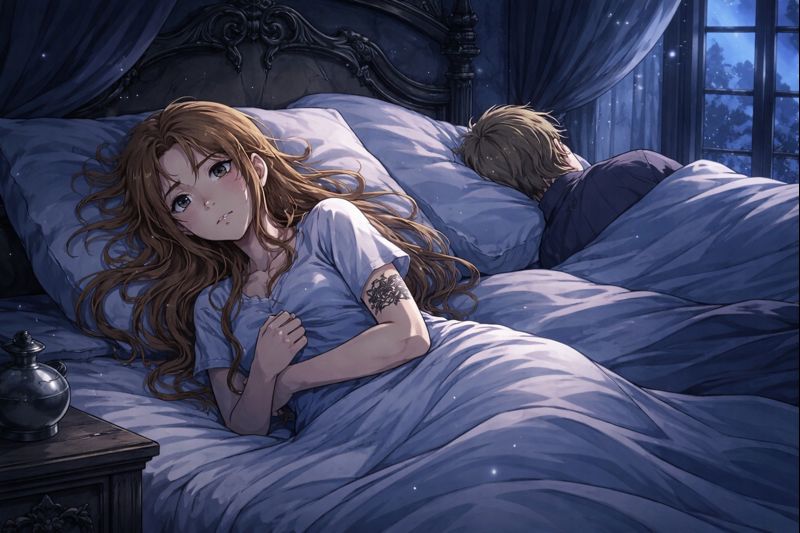
Feyre Archeron returns to the Spring Court after surviving Under the Mountain, but the victory has hollowed her out. Nightmares plague her sleep, food turns to ash in her mouth, and guilt over the lives she took eats away at her. Tamlin, equally traumatized, responds not with comfort but with control, sealing Feyre inside the manor and refusing to acknowledge the depth of her suffering. His obsession with protection slowly becomes suffocating, erasing Feyre’s agency and voice.
Though Tamlin sleeps beside her, beautiful and distant, he never wakes during Feyre’s episodes, and their shared silence only deepens her isolation. Feyre reflects that she destroyed herself to save him and Prythian, yet now faces an eternity carrying that damage, uncertain whether even immortality can heal what was shattered inside her.

Feyre clashes with Tamlin over his refusal to let her leave the manor to help rebuild a nearby village, revealing how tightly controlled and purposeless her life has become despite peace returning to Prythian. That night, Feyre and Tamlin reconnect in an intense, intimate encounter that briefly quiets her anxiety, but the moment fractures when Tamlin explains that there has never been a High Lady—only consorts—making clear that Feyre will never be his equal in power.
Feyre steps beyond the manor only to realize that even among the people she saved, she is no longer seen as a person but as a symbol—revered, constrained, and increasingly alone under the weight of immortality and expectation.
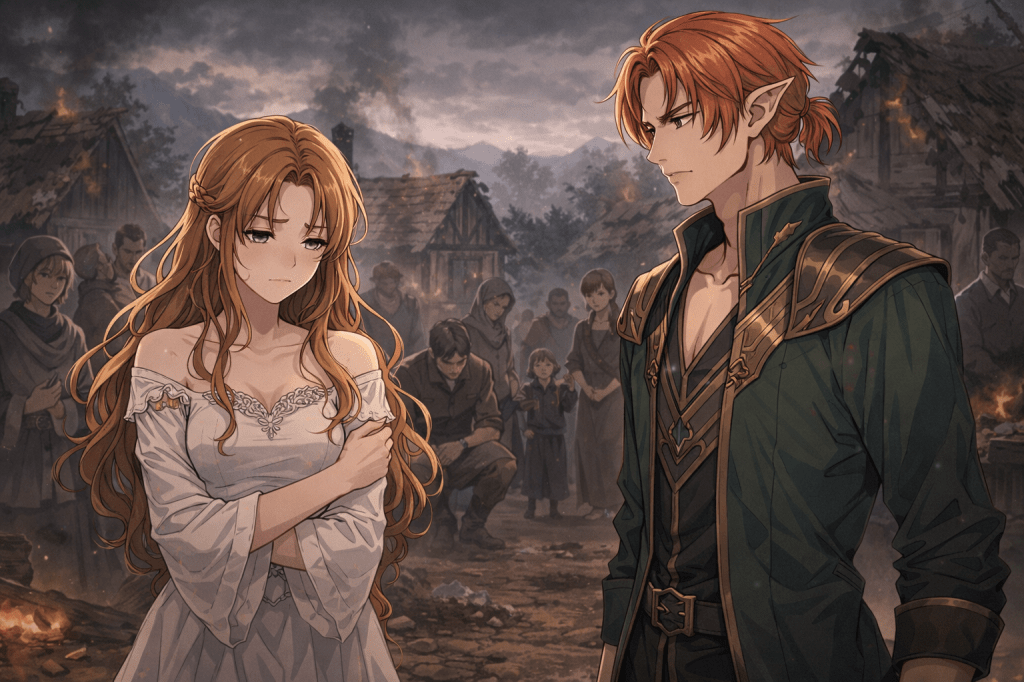
As Tamlin’s court prepares for their wedding, Feyre’s emotional collapse becomes impossible to ignore. On the day of the ceremony, panic overwhelms her, and she begs to be freed from a future she cannot survive. When Rhysand calls in the bargain Feyre made with him, spiriting her away to the Night Court one week each month, it becomes her first breath of air after months of drowning.
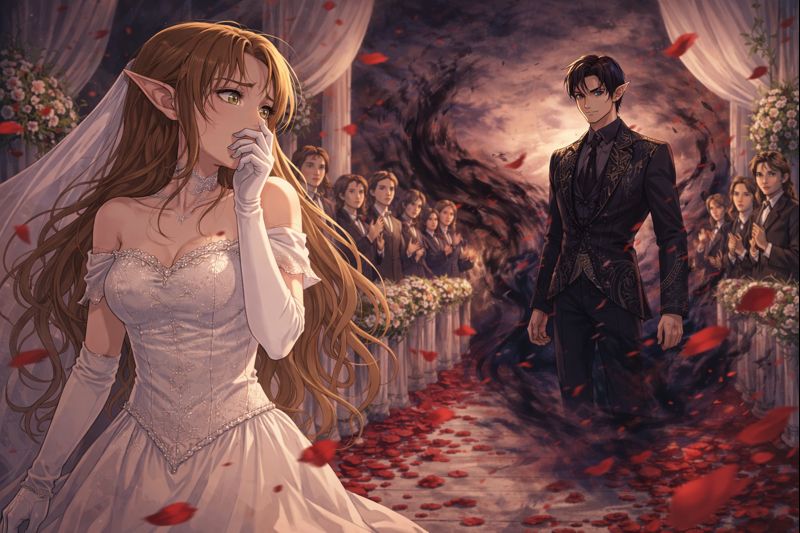
Feyre stands at the altar suffocating beneath expectations and unhealed trauma, and just as she silently breaks under the weight of a life she cannot choose, darkness arrives in the form of Rhysand—an interruption that cracks her cage wide open.
Feyre is pulled from a suffocating future into the Night Court, where Rhys confronts her pain head-on and offers not protection, but the first real tools she’s ever been given to reclaim her agency.
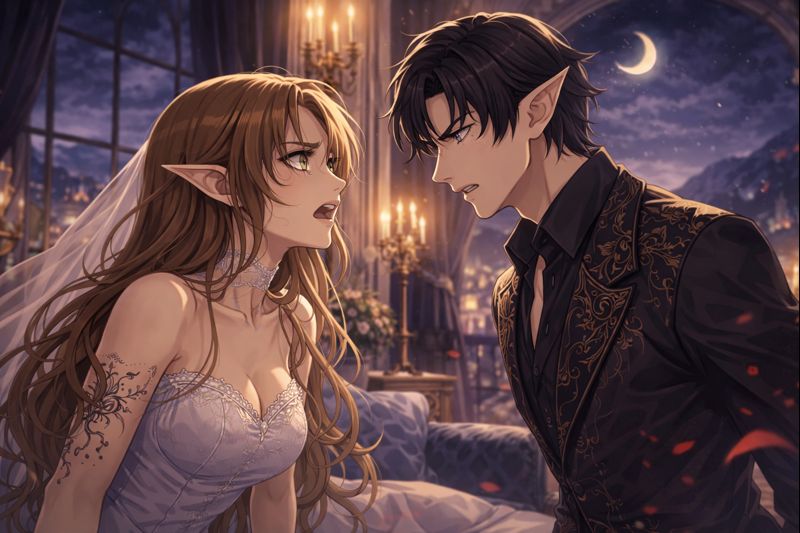
At the Night Court, Feyre expects cruelty and manipulation—but instead finds Velaris, a hidden city of art, laughter, and choice.
Rhysand introduces her to his Inner Circle: Mor, Cassian, Azriel, and Amren, who treat Feyre as an equal rather than a possession. Slowly, through reading lessons, physical training, and shared purpose, Feyre begins to heal. For the first time since her human life, she is allowed to exist without fear of punishment.
Feyre also learns the truth behind Rhysand’s reputation. His cruelty is a mask, deliberately cultivated to protect Velaris and those he loves. Under the Mountain, he endured decades of torture to keep his people safe, and Feyre begins to understand the cost of leadership and sacrifice. As she trains her newly inherited High Fae powers—gifts from all seven courts—she realizes she is no longer the fragile girl Tamlin tried to protect, but something powerful and dangerous in her own right.
The looming threat of the King of Hybern draws Feyre deeper into political conflict. Hybern seeks to destroy the wall separating the human and fae realms using the Cauldron, an ancient artifact of creation. Feyre and Rhys recover the first half of the Book of Breathings, then steal the second half from the Summer Court, knowingly shattering alliances to prevent catastrophe. The risks strain relationships but reinforce Feyre’s resolve to act rather than be acted upon.
As Feyre grows stronger, so does her bond with Rhysand. The truth of their mating bond is revealed, not as a claim or demand, but as something Rhys has honored silently to preserve Feyre’s freedom. When she chooses him—fully and without coercion—their relationship becomes one of partnership rather than protection. Feyre claims her place beside Rhys, emotionally and politically, as his equal.
That fragile peace is shattered when Hybern’s forces attack Velaris. Feyre defends the city, killing the Attor in a brutal confrontation that marks her transformation into a protector of the Night Court. The victory is short-lived. Feyre, Rhys, and the Inner Circle attempt to neutralize the Cauldron at Hybern’s stronghold, only to be ensnared by a carefully laid trap.
Captured and powerless, Feyre is forced to watch as her sisters, Elain and Nesta, are dragged into the Cauldron and Made into Fae against their will. Cassian’s wings are shredded, Azriel is poisoned, and the Inner Circle is held hostage. Tamlin’s betrayal is revealed: he allied with Hybern to reclaim Feyre, believing he was saving her. The cost of that “love” becomes undeniable.
To save her family and court, Feyre makes a devastating choice. She pretends to break free from Rhys’s influence, asks the King of Hybern to sever their bond, and allows Tamlin to take her back to the Spring Court. In reality, the mating bond remains intact—hidden but unbroken—and Feyre has sworn herself as High Lady of the Night Court in secret.
The book ends with Prythian on the brink of war. Feyre returns to the Spring Court not as a captive, but as a spy, prepared to dismantle Hybern’s allies from within. What began as a story of survival becomes one of transformation: from victim to ruler, from pawn to player, and from girl to High Lady, standing at the center of a war that will reshape the world.
Feyre Character Arc
At the start of the book, Feyre is alive but diminished. Her relationship with Tamlin reflects this state: protective, rigid, and built on fear rather than healing. Tamlin’s love manifests as control—locking her away, silencing her trauma, and deciding what is “best” without listening. Feyre internalizes this, believing her suffering is the price of survival and that her role is to endure quietly. She is powerful, but that power is suffocating under guilt, obligation, and the belief that she is dangerous when allowed agency.
Rhysand enters not as a rescuer, but as a mirror. He sees Feyre’s strength immediately and refuses to treat her as fragile or broken. Instead of shielding her from pain, he gives her tools: literacy, combat training, political awareness. Crucially, Rhys never forces her to accept these things. Feyre’s growth begins the moment she is given choice—real choice—and trusted to make mistakes. Through him, she learns that strength is not violence or endurance, but self-knowledge and consent.
As Feyre trains and works alongside Rhys, she begins reclaiming her identity beyond survival. She stops defining herself by what she has lost and starts shaping who she wants to become. In contrast to Tamlin, who wants her preserved and unchanged, Rhys encourages her evolution—even when it makes her more dangerous, more independent, and less controllable. Feyre’s power becomes something she owns rather than fears, and she starts to understand that love should expand her world, not shrink it.
The turning point in Feyre’s development is her conscious choice. She does not leave Tamlin because Rhys is her mate; she leaves because she recognizes that Tamlin’s love requires her to be smaller, quieter, and compliant. With Rhys, she is expected to participate, challenge, and lead. Choosing Rhys is not a rejection of safety—it is a rejection of erasure. Feyre steps fully into her strength by deciding that her autonomy matters more than anyone else’s comfort.
By the end of the book, Feyre is no longer reacting to trauma; she is acting with intention. Her decision to return to Tamlin as a spy is the clearest proof of her growth. This time, she enters the Spring Court not as a trapped girl, but as a strategist, a High Lady, and a woman who understands her power. Tamlin represents who she was when she believed love meant endurance. Rhys represents who she becomes when she realizes love is a partnership.
Feyre & Rhysand
Feyre and Rhysand begin the book bound by trauma and obligation rather than affection. Feyre associates Rhys with manipulation and humiliation from Under the Mountain, while Rhys sees a woman barely surviving the weight of guilt and unprocessed grief. Their bargain—one week a month in the Night Court—initially feels like another chain to Feyre, but it becomes the first space where she is not caged or silenced. Rhys offers her food when she cannot eat, training when she needs strength, and truth when she has been starved of it, never demanding gratitude or obedience in return.
As Feyre spends time in the Night Court, the power dynamic between them shifts. Rhys refuses to control her, even when he could, insisting she learn to read, fight, and choose for herself. The truth behind his cruel persona is revealed: that it is a mask worn to protect Velaris and his people, and that for decades he endured torture to keep others safe. Feyre begins to see Rhys not as a villain or savior, but as a man who bears unbearable responsibility—and who understands her pain without trying to erase it.
Their emotional intimacy deepens through shared purpose and honesty. Rhys becomes Feyre’s confidant, challenger, and anchor, pushing her to recognize her own strength rather than shielding her from the world. Feyre, in turn, sees through Rhys’s self-loathing and his belief that he is unworthy of love. When the truth of their mating bond is revealed, it reframes everything that came before—not as manipulation, but as restraint. Rhys knew, and chose to wait, honoring Feyre’s autonomy even at the cost of his own happiness.
Feyre’s choice of Rhys is deliberate and hard-won. She chooses him not because he is her mate, but because he treats her as an equal—someone whose consent, anger, ambition, and fear all matter. Their relationship becomes explicitly reciprocal: they plan together, fight together, and rule together. Rhys never asks Feyre to be smaller for his comfort, and Feyre refuses to let Rhys sacrifice himself alone. Love, for them, is not safety—it is trust under fire.
The relationship reaches its most devastating test at Hybern. When Feyre sacrifices herself by pretending to sever their bond and returning to Tamlin, Rhys understands the truth immediately: she is choosing the greater good, just as he once did. Their bond remains hidden but intact, a quiet promise beneath the loss and rage. By the end of the book, Feyre and Rhys are no longer simply lovers or mates—they are partners in war, bound by choice, sacrifice, and the shared certainty that they will burn the world down for each other if they must.
Fav Scenes/Tidbits
Below are 3 of my favorite scenes/tidbits. Though there were a lot more than this, I had to force myself to only share just a few, otherwise I’d basically be copying & pasting in the entire book.
Reading & Writing Practice
The only evidence I had at all that Rhys remained on the premises were the blank copies of the alphabet, along with several sentences I was to write every day, swapping out words, each one more obnoxious than the last:
Rhysand is the most handsome High Lord.
Rhysand is the most delightful High Lord.
Rhysand is the most cunning High Lord.
(page 73)
Live Bait
(note: some parts have been cut from scene below)
“Will he kill him?” I said, my puffs of breath uneven.
“No.” I shivered at the raw power glazing his taut body. “We’ll use him to send a message to Hybern that if they want to hunt the members of my court, they’ll have to do better than that.”
I started—at the claim he’d made of me, and at the words. “You knew—you knew he was hunting me?”
“I was curious who wanted to snatch you the first moment you were alone.”
“So you never planned to stay with me while I trained. You used me as bait—”
“Yes, and I’d do it again. You were safe the entire time.”
“You should have told me! ”
“Maybe next time.” (this made me LOL so hard)
“There will be no next time!” I slammed a hand into his chest, and he staggered back a step from the strength of the blow. I blinked. I’d forgotten—forgotten that strength in my panic. Just like with the Weaver.
“Yes, you did,” Rhysand snarled, reading the surprise on my face, that icy calm shattering. “You forgot that strength, and that you can burn and become darkness, and grow claws. You forgot. You stopped fighting.”
He didn’t just mean the Attor. Or the Weaver.
“So what if I did?” I hissed, and shoved him again. “So what if I did?”
I went to shove him again, but Rhys winnowed away a few feet. I whirled, grappling for him. He vanished before I could strike him, pound him.
Rhys appeared across the clearing, chuckling. “Try harder.”
I couldn’t fold myself into darkness and pockets. And if I could—if I could turn myself into smoke, into air and night and stars, I’d use it to appear right in front of him and smack that smile off his face.
…
I lunged as he vanished, lunging like I could disappear into the folds of the world as well, track him across eternity—
And so I did.
Time slowed and curled, and I could see the darkness of him turn to smoke and veer, as if it were running for another spot in the clearing. I hurtled for that spot, even as I felt my own lightness, folding my very self into wind and shadow and dust, the looseness of it radiating out of me, all while I aimed for where he was headed—Rhysand appeared, a solid figure in my world of smoke and stars.
And his eyes were wide, his mouth split in a grin of wicked delight, as I winnowed in front of him and tackled him into the snow.
I panted, sprawled on top of Rhys in the snow while he laughed hoarsely.
“Don’t,” I snarled into his face, “ever,” I pushed his rock-hard shoulders, talons curving at my fingertips, “use me as bait again.”
He stopped laughing.
I pushed harder, those nails digging in through his leather. “You said I could be a weapon—teach me to become one. Don’t use me like a pawn. And if being one is part of my work for you, then I’m done. Done.”
Despite the snow, his body was warm beneath me. Rhys cocked his head, loosening a chunk of snow clinging to his hair. “Fair enough.”
(chapter 26-27)
She’s a Threat
Devlon sniffed at me. I poured every bit of cranky exhaustion into holding his narrowed gaze. “Another like that … creature you bring here? I thought she was the only one of her ilk.”
“Amren,” Rhys drawled, “sends her regards. And as for this one … ” I tried not to flinch away from meeting his stare. “She’s mine,” he said quietly, but viciously enough that Devlon and his warriors nearby heard. “And if any of you lay a hand on her, you lose that hand. And then you lose your head.” I tried not to shiver, as Cassian and Mor showed no reaction at all. “And once Feyre is done killing you,” Rhys smirked, “then I’ll grind your bones to dust.”
I almost laughed. But the warriors were now assessing the threat Rhys had established me as—and coming up short with answers. I gave them all a small smile.
(page 398)
Thoughts
What makes this romance stand out is that Feyre is never coddled. Tamlin’s version of love is rooted in protection, but the story treats that protection honestly: as restrictive, silencing, and ultimately destructive. Feyre is not fragile—she is traumatized—and those are not the same thing. Tamlin responds to fear by building walls. Feyre suffocates behind them.
Rhysand, by contrast, explodes her world. He does not shield her from danger or decision-making; he insists she meet both head-on. Where Feyre lacks skill, he teaches her. Where she doubts herself, he challenges her. Where she tries to disappear, he forces her to take up space. He never asks her to be smaller for his comfort or safer for his peace of mind.
What makes this dynamic powerful is that Feyre’s strength is not discovered because of Rhys—but with him refusing to let her forget it exists. He treats her power as something to be developed, not feared; something to be wielded, not hidden. That is love rooted in respect, not possession.
This is why Feyre choosing Rhys feels earned. Not because he is her mate, but because he is the one person who never mistakes control for care. He doesn’t protect her from the world—he prepares her for it. And that, more than anything else, is what allows Feyre to become who she was always capable of being.





 Green Where You Water It
Leave a comment