
The woman didn’t think of it as vengeance. She thought of it as intervention.
Her son’s wife was difficult. Cold when she didn’t need to be. Sharp in small ways that left no proof. She never raised her voice, never crossed a line cleanly enough to be named—but she made it clear who now held priority.
The woman didn’t go to the voodoo man to hurt anyone. That’s what she told herself as she nervously eyed the skull at the center of the altar. At least there were roses around it. That had to count for something. Balance things out.
She went because her son had changed.
Since the marriage, he spoke differently. Less often. He no longer called every morning. He defended his wife with a calm finality that felt like betrayal.
“She’s taken him from me,” the woman said to the voodoo man, hands folded tightly in her lap. “I just want things put back the way they were.”
The man listened. He always did. He didn’t interrupt. He didn’t moralize. When she finished, he asked only one question.
“Who shares your blood?”
“My son,” she said immediately. Then, after a pause, “And my daughter.”
He nodded once, slowly.
“What you ask for travels through blood,” he said. “It does not take roads. It takes roots.”
She waved a hand. “My daughter has nothing to do with this.”
The man looked at her then, really looked. “That’s not how it works.”
But the woman had already decided. She had brought the hair, the name, the photograph of the wife smiling too confidently beside her son. She wanted discord. Sleeplessness. A loosening of attachment, of certainty, of whatever held the marriage so tightly in place. Enough to make the girl leave on her own.
“I don’t want her ruined,” the woman said, anxious to be precise. “Just unsettled.”
The voodoo man sighed, almost imperceptibly.
“You may not get to choose who pays,” he said.
She dismissed this as mysticism trying to sound wise and gave him a velvet purse containing her wedding bangles.
At first, nothing obvious happened.
The wife grew tired. Distracted. She and the son argued more. The woman felt a small, sublime satisfaction. She told herself this was balance being restored.
Meanwhile, her daughter began calling more often.
“Sorry I missed your call earlier,” she said at once. “It’s been hectic. Everything seems to be going wrong, and I’m so tired all the time. Anyway, what did you need?”
The woman laughed lightly. “You’re stressed. You always take things on. Don’t worry about it, it’s resolved now.”
There was a pause.
“Mom,” the daughter said carefully. “You didn’t go to that person, did you?”
The woman huffed. “Never you mind what I did or didn’t do. Did you eat yet?”
On another evening, the daughter called again.
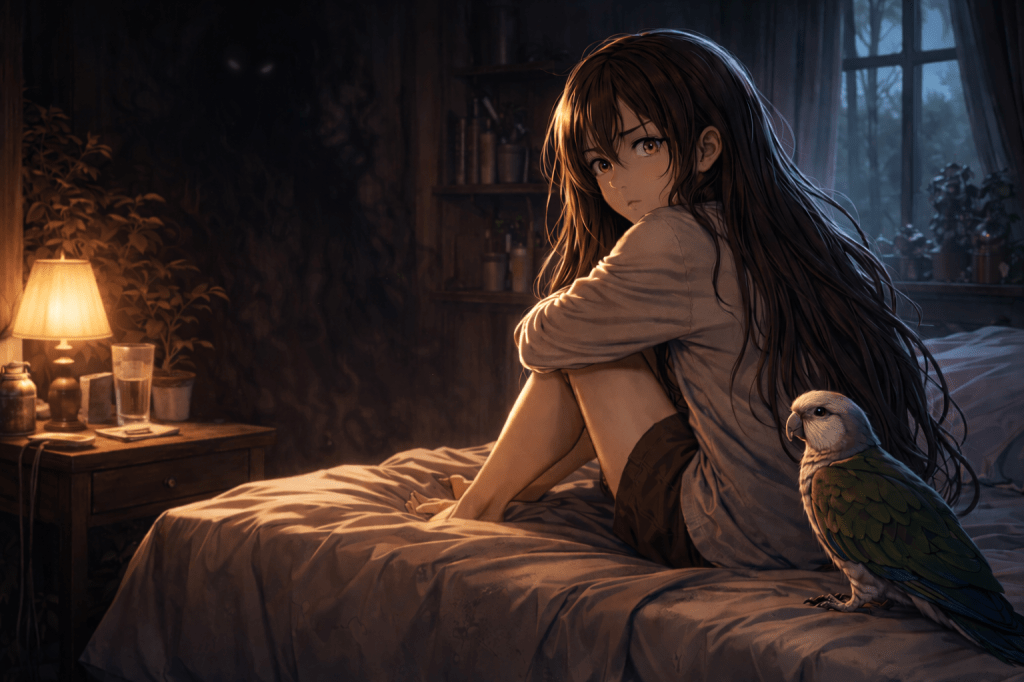
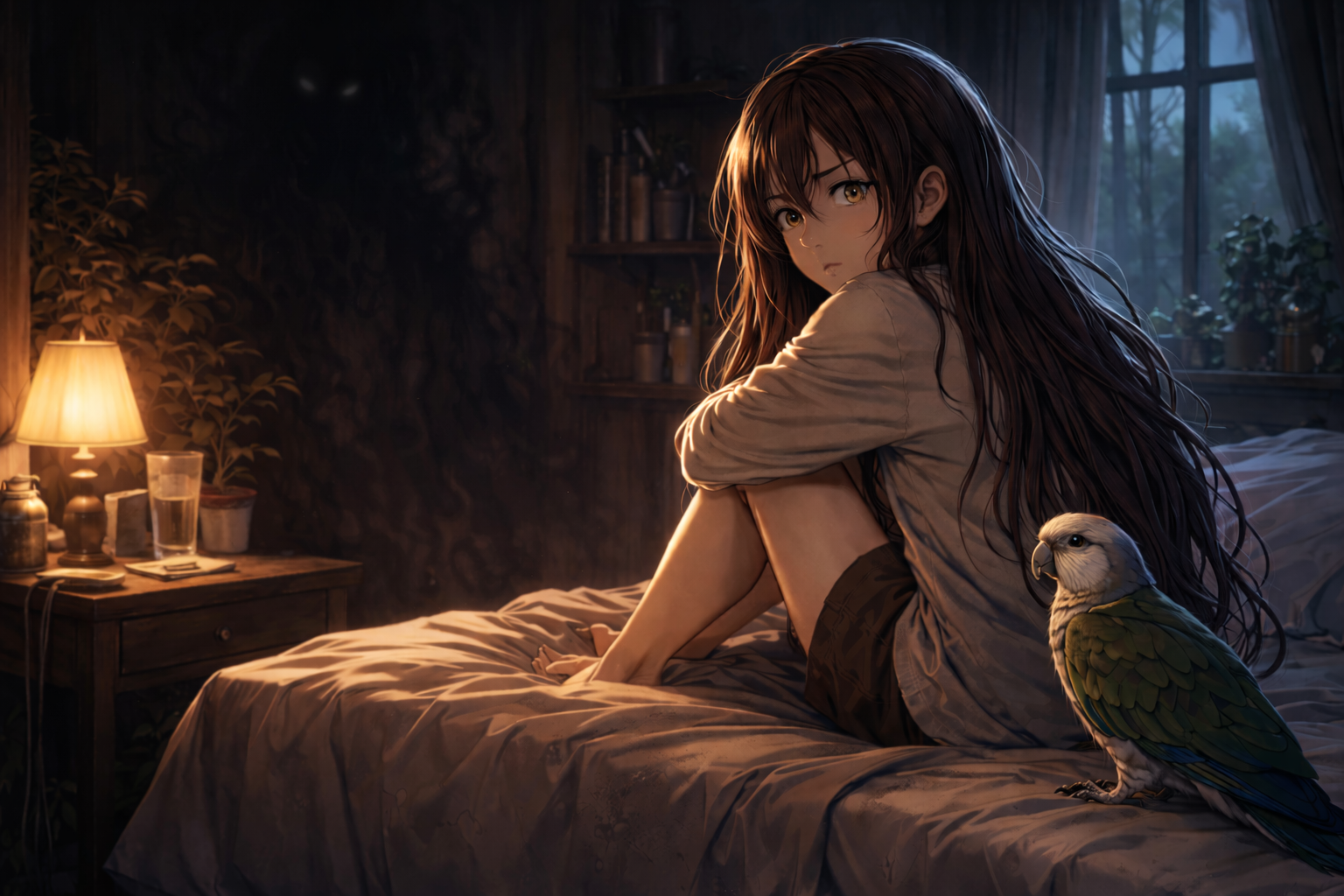
“This is going to sound stupid,” she said, forcing a laugh. “But Orion, my new pet bird, keeps staring at the corner of the room. Or at the air. Then he gets scared for no reason.”
“What could it be seeing?” the woman asked, half amused.
“I don’t know. And I’m not sleeping. I keep having nightmares—like something’s in the room with me. Sometimes I wake up feeling like something is lying in the bed next to me.”
The woman listened, then said earnestly, “You should pray. You’ve stopped praying.”
“I do pray when that happens,” the daughter said. “And then it’s fine.”
“Good,” her mother replied. “But you should always be praying.”
The woman considered the matter settled.
But Orion continued acting strangely—watching empty space, bristling at nothing, refusing to enter certain rooms. At night, the daughter dreamed of standing in her apartment while something stood just behind her, close enough to breathe.
She woke soaked in sweat, heart racing, the sense of being observed clinging to her long after the dream dissolved.
Her life began to unravel in small ways.
Jobs fell through at the last moment. Dinnerware broke. Friendships thinned. Every effort seemed to slide sideways, as if something nudged outcomes just enough to fail.
Nothing catastrophic—just a steady accumulation of almosts and not-quites.
Meanwhile, the son’s wife stabilized.
She slept better. Her moods evened out. She laughed more easily, as if something heavy had passed through her rather than taken hold. She even softened, just a little—not kinder, exactly, but calmer. Less reactive.
The woman noticed this with approval.
See? she thought. It worked.
The daughter tried once again, carefully, to explain.
“I feel like something’s wrong,” she said. “Like something is with me all the time. It’s not completely bad—but it doesn’t feel good either.”
The woman frowned. “You’re being dramatic. Nothing happened to you.”
And because nothing had happened that could be explained, the conversation ended there.
Years later, the daughter learned to live with unease the way some people live with chronic pain—quietly, without expecting relief. She trusted animals more than people, relying on them to sense when the presence was near. She chose her spaces carefully. She avoided mirrors. She never fully relaxed, accepting that ease came harder to her than it seemed to for others.
The woman noticed only that her daughter had become withdrawn.
“She isolates herself,” she told others, shaking her head. “And she doesn’t want to get married.”
She never connected this to anything. Not to the visit. Not to the request. Not to the way harm, once invited, does not require direction to travel.
Eventually, the son called less. His wife remained distant.
But she was tired now.
The woman took this as proof she’d been right all along.
When people asked about her daughter, the woman sighed in a way that suggested long-suffering patience.
“She’s always struggled,” she said. “Some people just do.”
She spoke fondly of her daughter’s caution, her solitude, her sensitivity. Framed it as temperament. As destiny.
She never wondered why her daughter trusted animals more than people. Never questioned the way she avoided mirrors or chose apartments where nothing could get to her.
And because the struggle had no visible origin—no accident, no loss that could be pointed to—no one argued. Least of all her.
But blood remembers. And what she had invited in never fully left.





 Green Where You Water It
Leave a comment