
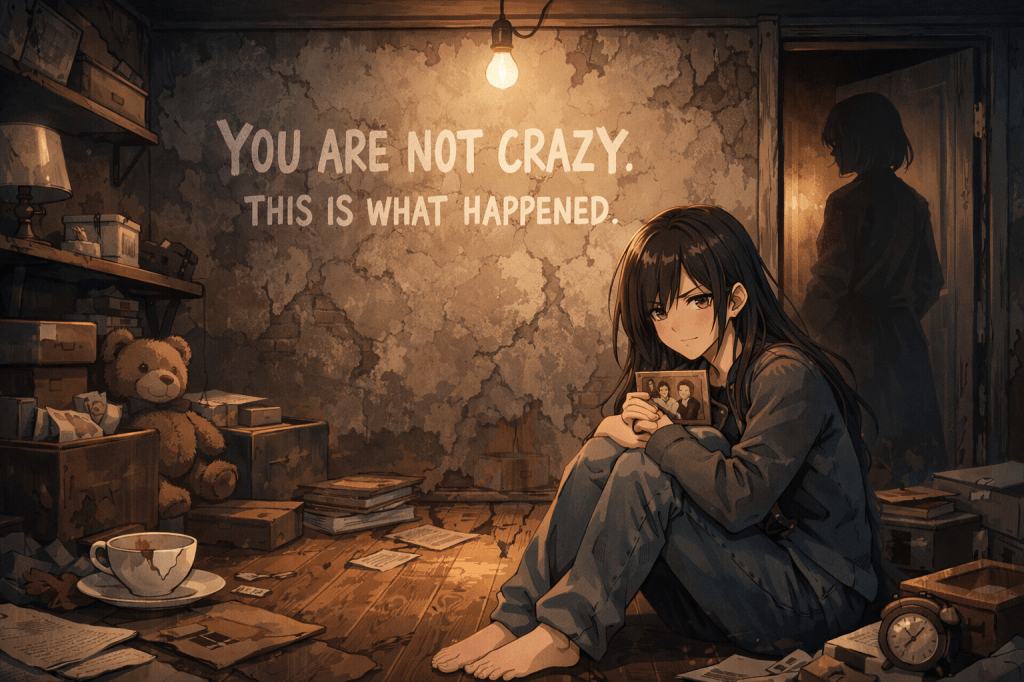
The house corrected her when she remembered the things that went wrong.
At first, it was small things. A door she swore had once opened inward now swung out. A crack in the ceiling vanished. A photograph on the stairs showed fewer people than she recalled, like the house had decided someone no longer counted.
“Memory does that,” her mother said pleasantly, the way people speak when they are being kind on purpose. “It smooths things out.”
But the smoothing always went one way.
When the girl—no, the woman, she corrected herself—said the shouting used to last for hours, the walls softened. The acoustics changed. Sound stopped carrying. When she said the silence afterward felt worse, the windows thickened, muting the outside world until the quiet felt reasonable. Safe.
“You were sensitive,” her mother said, setting down a teacup that never chipped no matter how often it was dropped. “Nothing actually happened.”
The house agreed.
The woman learned to test it.
She left a book on the table before bed, spine cracked, page folded. In the morning, it was back on the shelf, pristine, unread. She scratched a mark into the wood under the dining chair. By noon, the floor had grown a new grain pattern, seamless, innocent.
The house didn’t erase everything. Just enough.
People visited sometimes. Friends of her mother. Neighbors. They walked through the rooms and nodded approvingly, remarking on how calm it felt, how warm, how normal.
“She’s still stuck on the past,” her mother told them gently, and they looked at the woman with sympathy that felt like dismissal wrapped in silk.
“Have you tried letting go?” one asked, as if offering a useful tip.
The woman stopped answering.
Instead, she began collecting what the house couldn’t digest.
She hid objects in places that didn’t belong to the house: inside the hollow of a dead tree out back, beneath the loose stone by the creek, in the glove compartment of her car. She wrote things down, not in journals—the house loved journals—but on scraps of paper folded into origami shapes and tucked into shoes, coat linings, between the pages of library books she never returned.
She learned the rules by watching.
The house could rewrite spaces, but not movement. It could revise events, but not patterns. It could deny pain, but it struggled with repetition.
So she repeated herself.
She said the truth aloud every night before sleep, not loudly, not angrily—just clearly. She listed names. Dates. The way time stretched. The way it shrank. The feeling of being told she was fine when she wasn’t.
At first, the house shuddered.
Then it adapted.
Her mother began finishing her sentences for her, always softer, always kinder, always wrong. “You mean it felt like that,” she’d say. “You mean you were confused.”
The house rearranged itself so the woman’s bedroom grew smaller. Her closet shrank. Her mirror distorted her face just enough to make her hesitate before trusting it.
One night, the woman found a room that hadn’t been there before.
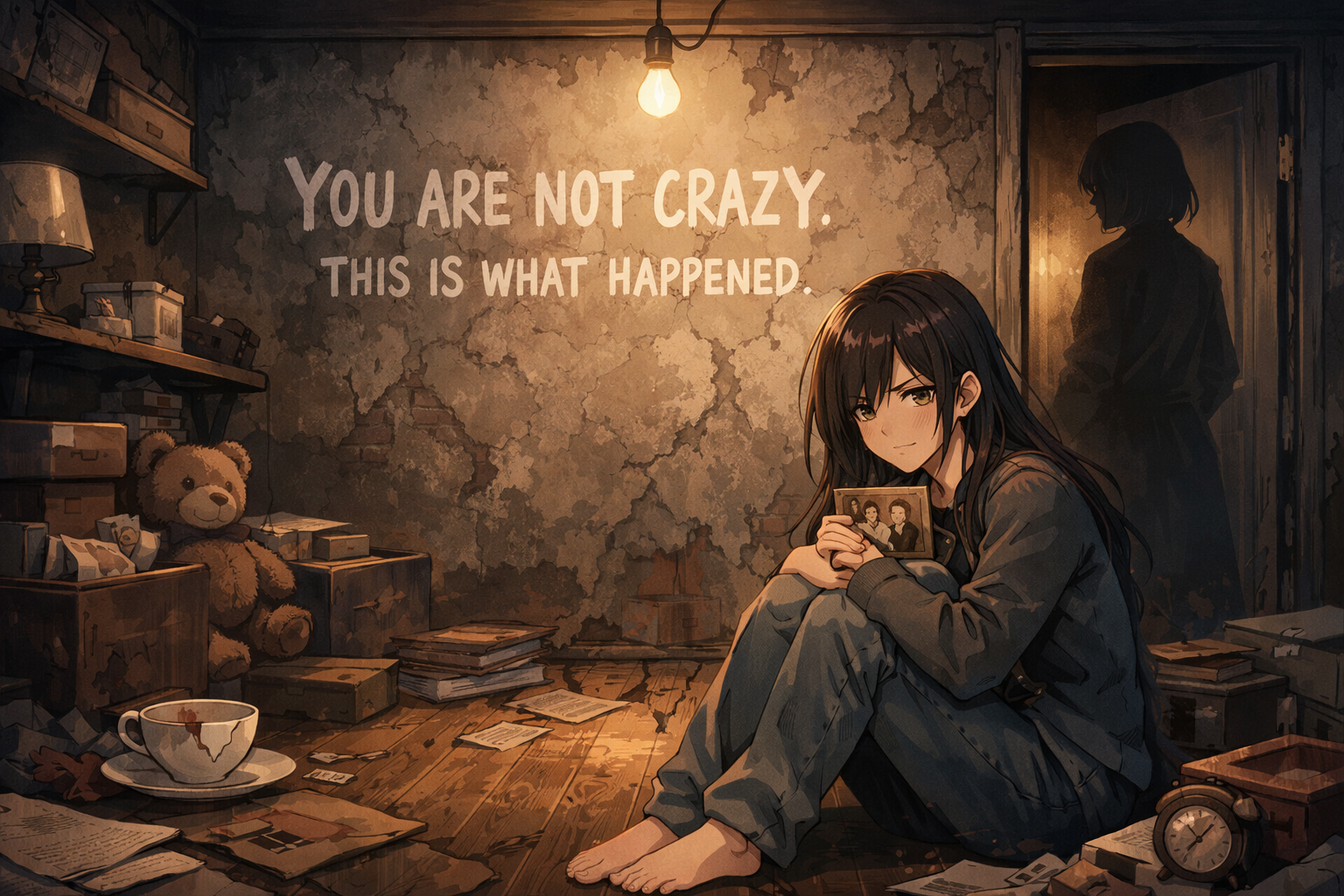
It was narrow and windowless, hidden behind a door that blended perfectly into the hallway. Inside were all the things the house had removed: the cracked teacup, the marked floorboard, the version of the photograph with everyone still in it.
And written across the far wall, in her own handwriting, were the words:
YOU ARE NOT CRAZY.
THIS IS WHAT HAPPENED.
Her hands shook. The room vibrated, as if the house were holding its breath.
Her mother stood in the doorway.
“Oh,” she said, smiling sadly. “You found that.”
The woman turned. “You knew.”
“I knew you needed somewhere to put it,” her mother replied. “Everyone needs stories.”
“This isn’t a story.”
Her mother tilted her head. “It’s just not useful anymore.”
The house began to hum. The walls pressed inward.
The woman understood then: the house didn’t exist to protect people. It existed to protect continuity. Comfort. Appearances. The lie that nothing truly breaks.
She stepped fully into the room and closed the door behind her.
The house resisted. The floor warped. The air thickened. But the room held.
She took the photograph off the wall and pressed it to her chest. She read the words again, slowly, like a vow.
The house could shrink her space. It could make her inconvenient. It could convince others she was difficult, emotional, stuck.
But it could not follow her into a room built entirely out of truth.
By morning, the house had sealed the door.
Her mother told visitors the room had never existed.
And somewhere inside the walls, the woman sat surrounded by evidence, breathing steadily, no longer trying to be believed—only making sure the truth stayed alive.
That would be enough…for now.








 Green Where You Water It
Leave a comment