
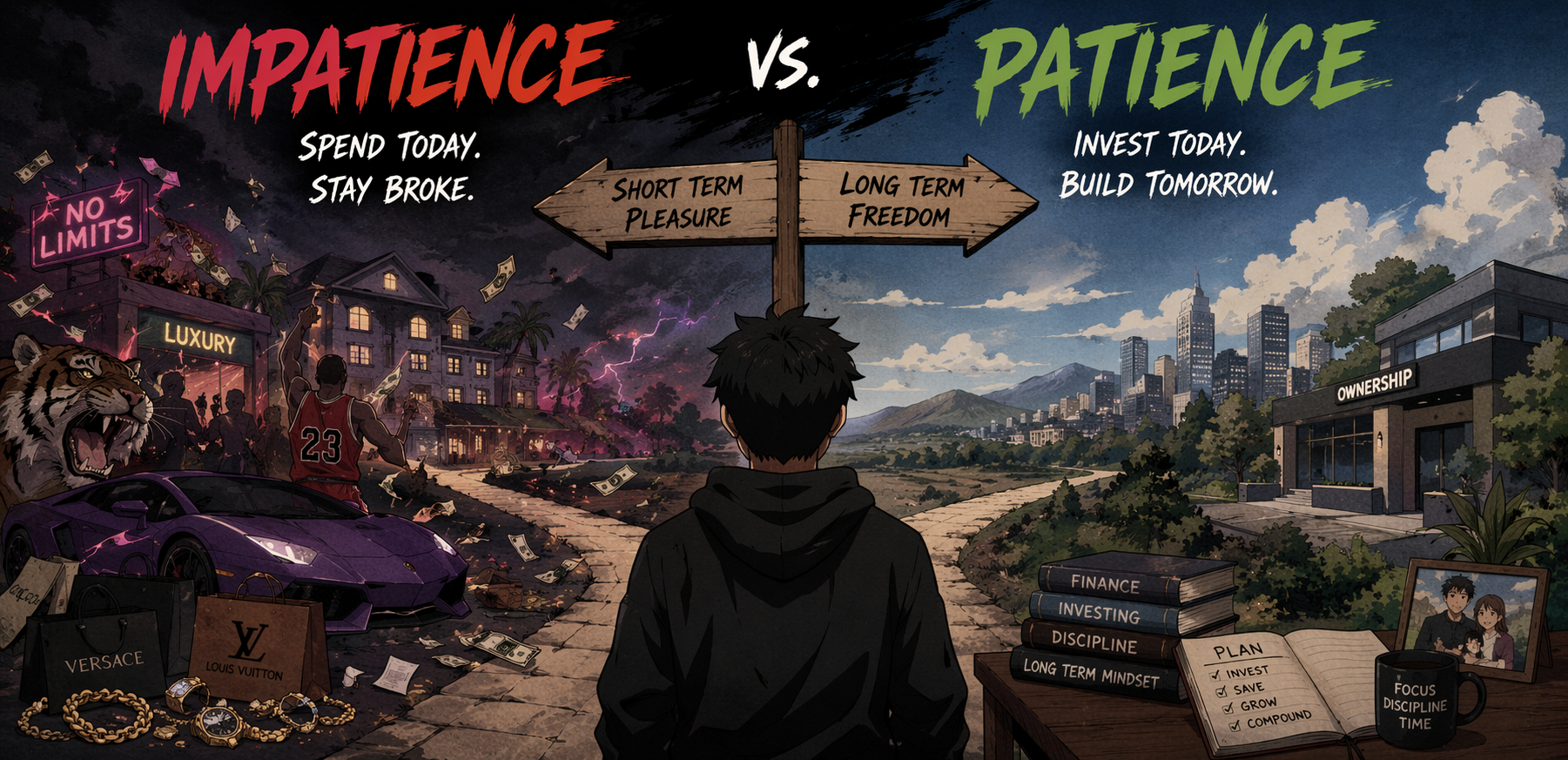
There’s a version of your money that could change your life. Most people never meet it because they spend it too soon.

It’s March 2020. Markets are in freefall. Your $40,000 portfolio is now worth $26,000 and every financial headline is using the word collapse. One investor sells — stops the bleeding, moves to cash, waits for clarity. Another does nothing. Fourteen months later, the one who sold is still waiting for the right moment to get back in. The one who did nothing is up 18% from where they started. The difference between them wasn’t knowledge, income, or nerve. It was the willingness to let time finish what panic wanted to interrupt.
Investing doesn’t reward intelligence the way people think it does. It rewards restraint. Two people can pick the same investments, earn the same income, and start at the same time—and end up in completely different places.
The difference is what happens in the quiet moments. One checks constantly, reacts to every dip, takes profits early, changes direction when things feel slow. The other leaves it alone. Lets time do what it’s designed to do.
Why impatience is so expensive
Impatience interrupts compounding before it has a chance to work.
Selling during a dip locks in losses. Jumping to a new strategy resets the clock. Withdrawing early erases years of silent growth. Each move feels rational in the moment. Collectively, they hollow out returns over a lifetime.
The impatient investor isn’t stupid. They’re just tracking the wrong timeline. They’re watching months when they should be watching decades. They’re reading the score at half-time and concluding the game is lost.
What patience actually means
Patience gives your cash space to become something bigger than the original decision. It isn’t passivity. It’s not watching your savings account and hoping. It’s something more demanding: the ability to delay visible results without losing faith in the process.
Patience in investing is the refusal to confuse movement with progress. The instinct to do something feels like competence. When you’re rebalancing, switching funds, taking profits, cutting losses, it feels like you’re managing the situation. But markets don’t reward activity; they reward presence. Every unnecessary trade has a cost: transaction friction, tax events, and most expensively, the compounding you interrupted.
The investor who holds through a 30% drawdown and recovers isn’t lucky — they’re practicing the hardest skill in finance: tolerating visible pain in service of an outcome they can’t yet see.
This is what separates long-term thinkers from short-term chasers: not intelligence, not information, not access. Just the ability to stay in the seat when everything in your nervous system is telling you to stand up.
Patience is the ability to hold, manage, and grow money instead of consuming it immediately.
Mike Tyson — The Rise, the Flood, and the Silence After (A Case Study in Impatience)
He was a kid from Brownsville, Brooklyn, the kind of place where survival hardens you early and softness gets stripped out fast. By the time Mike Tyson was a teenager, violence wasn’t foreign—it was language. Fighting wasn’t a career yet. It was instinct.
Then came Cus D’Amato.
Cus didn’t just see a fighter. He saw a system. A mind that could be shaped, disciplined, controlled. He took Tyson in, gave him structure, routine, belief. He taught him that fear wasn’t something to eliminate—it was something to master. Tyson trained obsessively. Hours in the gym. Repetition until movement became reflex. There was no rush in that phase. Just quiet, focused development.
And it worked.
At 20 years old, Tyson became the youngest heavyweight champion in history. It wasn’t just that he won—it was how he won. Fast. Violent. Overwhelming. Opponents didn’t last. Fights ended before they could even settle in. He wasn’t climbing slowly. He was exploding onto the scene.
Money followed the same pattern.
Large purses. Sponsorships. Fame that didn’t build gradually—it arrived all at once. Tyson went from having nothing to having more than most people could process in a lifetime. And here’s where the shift happened. The discipline that built him didn’t transfer to the money.
Cus D’Amato died in 1985. That structure—the one thing holding everything together—was gone.
What replaced it wasn’t patience. It was access.
The spending didn’t creep up. It surged. Mansions, luxury cars, jewelry. Not one or two purchases—dozens. He bought Bengal tigers. Gold bathtubs. Properties he barely lived in. There was no pause between earning and consuming. Money wasn’t something to manage. It was something to express.
Around him, the ecosystem changed too. Advisors, promoters, people who benefited from his flow of money rather than protecting it. Tyson trusted easily. Signed contracts without understanding them. Lived without friction. If something caught his attention, he bought it. If someone asked, he gave.
And the income kept coming, so it didn’t feel like a problem.
This is the part most people misunderstand. Financial collapse rarely feels like collapse while it’s happening. It feels like momentum. It feels like abundance. The money is still coming in, so the system doesn’t look broken. But underneath, there’s no foundation being built. No patience layer. Nothing is compounding. Everything is flowing outward.
Then life started to fracture.
Legal troubles. Prison. Time away from the ring. And here’s where impatience becomes expensive. Because when your income is tied to performance—and that performance stops—the system gets exposed.
The expenses didn’t slow down. The lifestyle didn’t shrink. The money just… wasn’t there anymore.
By 2003, Tyson filed for bankruptcy.
Over $400 million earned. Gone.
What’s left after something like that isn’t just financial damage. It’s psychological. The identity that was built around being unstoppable, untouchable—it cracks. The noise fades. The crowds disappear. And what remains is the silence of consequences catching up.
In later years, Tyson would speak differently. Slower. More reflective. There’s an awareness that wasn’t there before. He talks about ego, about lack of control, about not understanding what he had while he had it. There’s no denial in it. Just recognition.
Because the truth is, Tyson didn’t lose his wealth in one moment.
He lost it in thousands of small, impatient decisions. Decisions that felt harmless because the money was always there to cover them. Until it wasn’t.
His story isn’t about failure in the ring. It’s about what happens when success comes faster than the character needed to hold it.
And what happens when no one teaches you how to let something grow instead of spending it the moment you receive it.
LeBron James — The Long Game (A Case Study in Patience)
He grew up in Akron, Ohio. Not in chaos the way some stories are told, but in instability. Moving from apartment to apartment. A single mother doing everything she could to keep things together. There wasn’t much structure, but there was just enough awareness for LeBron to understand what was at stake.
Basketball came early. Not just as talent, but as direction. By high school, he wasn’t just a good player—he was a national story. Cameras at games. Scouts everywhere. Expectations that didn’t wait for adulthood.
Most people, when they get that kind of attention that young, start to speed up. They chase it. They try to match the hype with immediate results.
LeBron slowed down.
Not in effort—he worked relentlessly—but in how he approached the future. He didn’t treat success like something to spend. He treated it like something to structure.
When he entered the NBA in 2003, the money came fast. Rookie contracts, endorsements, global attention. He could’ve followed the usual script. Big house. Big lifestyle. Immediate upgrades across the board.
Instead, he built a team.
Not just agents and managers—but people who had been with him before the money showed up. LRMR Marketing wasn’t built by outsiders. It was built with his childhood friends. People he trusted. People who had grown with him, not attached themselves to him.
That decision alone changed the trajectory.
Because now, the people managing the money weren’t incentivized to extract from him. They were incentivized to grow with him.
LeBron didn’t rush into ownership deals. He didn’t take every endorsement offer. He passed on short-term money for long-term positioning. One of the most defining moves—he chose equity with Nike over quick payouts. That decision compounds over decades. Not months.
And he kept reinvesting into himself. Millions spent on his body every year. Training, recovery, nutrition. All for longevity. He understood early that his earning power was tied to how long he could perform at the highest level. So instead of extracting everything he could immediately, he extended the timeline.
That’s patience in a different form. While others burned bright and faded, he stayed consistent. Year after year. Not chasing spikes. But maintaining excellence.
Off the court, the same pattern repeated.
He moved into ownership. Media. Production. Strategic investments. Not random bets—calculated entries into industries that would outlast his playing career. SpringHill Company wasn’t a side project. It was infrastructure for a second career.
And through all of it, there’s a noticeable restraint.
You don’t hear stories about reckless spending. You don’t see the same level of excess. That doesn’t mean he doesn’t enjoy his money. It means there’s a gap between earning and consuming. A buffer where decisions are made with the future in mind.
That gap is everything. Because it allows money to settle. To be directed. To multiply.
By the time LeBron became a billionaire, it didn’t feel sudden. It felt like the natural outcome of years of aligned decisions. Nothing about it was rushed. Nothing depended on a single moment. It was built the same way his career was built. Deliberately.
What makes his story different isn’t just intelligence or access. It’s that he never treated money like something that needed to be spent to be real. He let it sit. Let it grow. Let it turn into something bigger than the original paycheck.
Where most people see money as something to use, he saw it as something to build with. He had the same starting point as many elite athletes. Same level of opportunity. But a completely different relationship with time. And that’s what turned income into wealth.
How to Build the Patience Muscle
Patience isn’t a personality trait you either have or don’t. It’s a practice — and like most practices, it gets easier when you remove the conditions that make it hard. Here are some suggested steps:
- Start by automating your investments so the decision happens without you. Direct debits don’t panic. They don’t read headlines. They just move money on schedule, every month, regardless of what the market is doing.
- Next, change what you measure. If you’re checking your portfolio weekly, you’re optimising for anxiety. Switch to quarterly reviews at most, and train yourself to look at five-year charts instead of five-day ones.
- Then build what LeBron built and Tyson never had: a gap between earning and spending. Not a big gap at first — just a pause. A moment where money sits before it moves. That pause is where wealth is decided.
- Finally, find your version of the boring account. Not the exciting opportunity. Not the hot sector. The unglamorous, automatic, set-it-and-forget-it vehicle that compounds quietly in the background while you get on with your life. The goal isn’t to make investing exciting. The goal is to make it irrelevant to your daily mood.
The Bottom Line
There’s a version of your money that most people never meet — not because it was out of reach, but because it was spent too soon, moved too early, or faith was lost before the compounding had time to show its hand. Tyson had $400 million and left with nothing because every dollar that came in found its way out before it could multiply. LeBron had the same access to wealth and treated it like something to build with rather than burn through. The difference was never income. It was time — and the willingness to leave things alone long enough for time to do its job. You don’t need a perfect strategy. You don’t need to outthink the market. You just need to stay in the seat longer than your instincts are telling you to.
So here’s the only action that matters this week: open your investment account, set up one automatic transfer into an index fund — whatever amount doesn’t hurt — and then close the app. Don’t check it again until next quarter. That single habit, repeated without interruption for the next decade, will do more for your financial future than any stock tip, any market prediction, or any clever move you’ve been waiting to make. The best investment decision you’ll ever make is the one you set up and then leave alone.

![Book Summary: The Devil and the Dark Water [FULL SPOILERS]](https://gwuwi.com/wp-content/uploads/2026/10/The-Devil-and-the-Dark-Waters.png)






Leave a Reply