
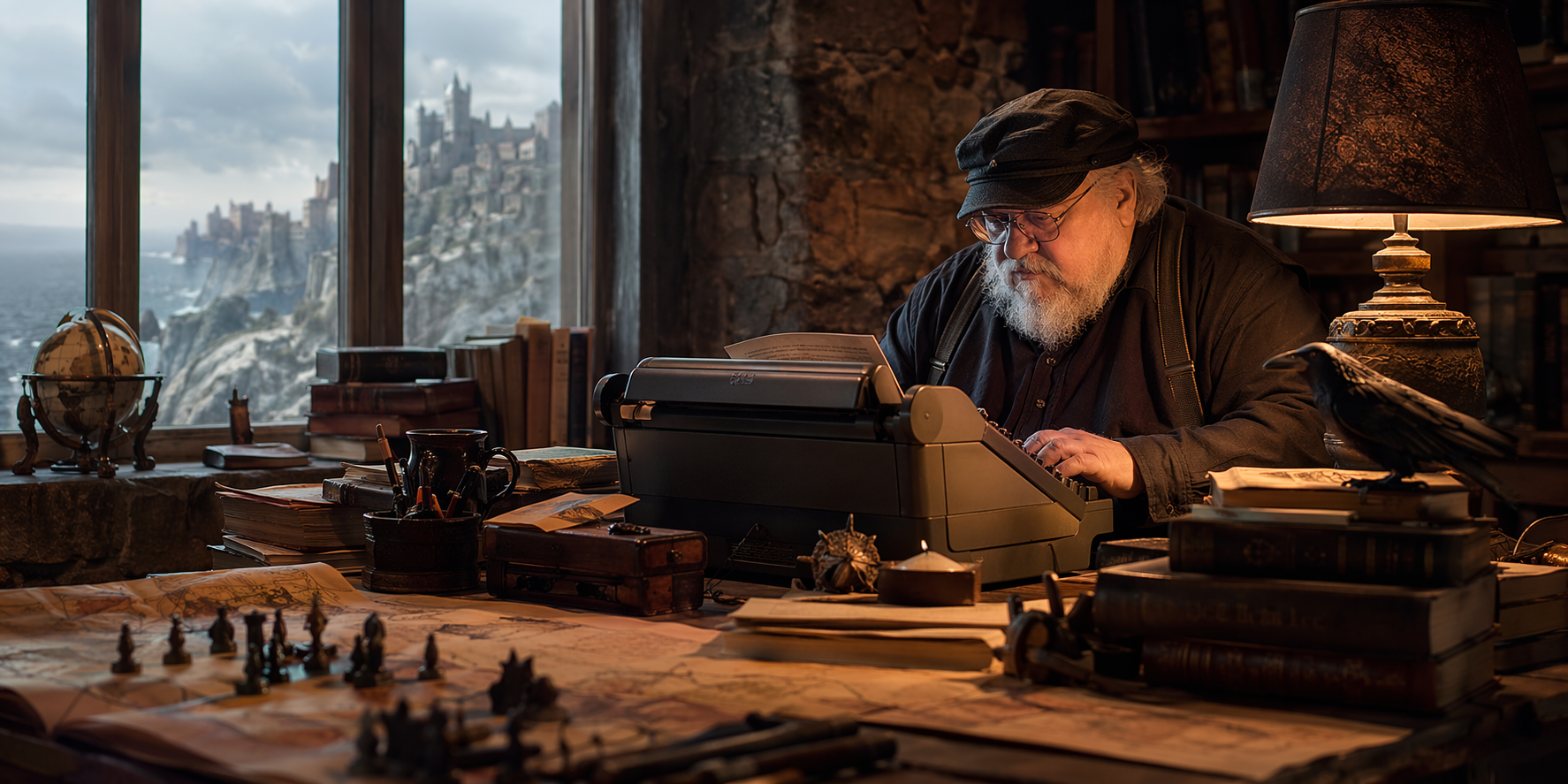

There’s a running joke in the Game of Thrones fandom: the next book, The Winds of Winter, is the Schrödinger’s cat of fantasy literature — simultaneously finished and perpetually unfinished, depending on which corner of the internet you’re visiting. But behind the memes about Martin’s writing pace lies a genuinely fascinating creative process, one built not on rigid discipline or word-count obsession, but on something far more interesting: deep immersion, structural ingenuity, and a relentless commitment to getting it right.
Here’s a thorough look at how one of the most ambitious storytellers alive actually does the work.
The Gardener, Explained Thoroughly
Martin has a famous way of dividing writers into two camps. Architects plan everything out in advance — detailed outlines, beat sheets, the whole blueprint before a word of actual prose gets written. Gardeners plant seeds and see what grows.
Martin is a gardener. But he’s not technically winging it. His self-description is more precise: he usually knows where the story is going — the major destinations, the big set pieces, the broad strokes of an ending — but he discovers the path during the act of writing. The details emerge from the work itself, not from a pre-constructed outline.
He uses a travel analogy that’s worth sitting with: he knows the major stops on the journey, but not every turn, detour, or rest stop along the way. That distinction — macro intention, micro discovery — is the core of how he operates.
The practical implication is that plot isn’t “locked” when he starts drafting. It’s tested by scenes. When a scene reveals an unforeseen constraint, he rewrites. When a character goes somewhere unexpected, he follows. That’s why his stories feel alive. Characters make decisions that change the path, and instead of forcing them back onto a rigid outline, he adapts.
The tradeoff is obvious. You gain depth and realism, but you lose speed and predictability.
When earlier assumptions turn out to be wrong, he goes back and changes them. He considers restructuring to be a normal, expected part of the process and doesn’t see it as a failure — because in discovery writing, it’s how the story corrects itself and the real story begins to emerge.
What makes this structurally significant is that it rules out a certain kind of editing. You can’t finalize early chapters before the late ones are written, because the late ones will teach you things the early ones need to know. Martin has been explicit about this: it’s one of the core reasons he resists publishing chapter-by-chapter. Serialization would freeze decisions that need to stay fluid. Once a chapter is in print, the freedom to revise it in light of later discoveries is gone.
He’s expressed a wistful wish that he could have written all the books before publishing the first one. e. Economic reality made that impossible: you have to sell Book One to fund Book Two. But the wish reveals the underlying logic of his method: the whole story is, ideally, one continuous act of composition, and unfortunately publication locks in decisions, removing the freedom to go back and change what earlier volumes established.
The Writing Environment: Old-School on Purpose
Here’s where things get wonderfully eccentric, and where the eccentricity turns out to be principled.
Martin writes his novels on a DOS machine using WordStar 4.0 — a word processor from the early 1980s that predates the internet, Windows, and most of the people reading this. That machine is physically separate from any internet-connected device. No Wi-Fi, no browser, no notifications, no ambient pull of the outside world.
He’s been explicit about the reasons: stability, virus avoidance, and a preference for a clean, text-focused interface with no distractions. The simplicity of WordStar — just words on a screen — suits the kind of deep focus his work demands.The physical separation from the internet removes distraction not by willpower but by architecture. You can’t check Twitter on a machine that doesn’t know Twitter exists.
There are practical consequences to this setup. When he needs to share material — an excerpt for a website, a chapter for a publisher — assistants translate his WordStar files into modern formats. It’s friction. He’s accepted that friction as the price of a system that works for him. He also maintains meticulous backups: mirrored drives and frequent physical copies, with awareness that fire is a real risk to co-located backups.
The lesson here isn’t “use WordStar.” It’s that he’s designed his environment around the specific cognitive state his work requires, and he treats that design as seriously as the writing itself. The infrastructure is a creative decision.
On Momentum, Trances, and Bad Days
Martin doesn’t talk about daily word quotas or fixed schedules. He talks about momentum. He doesn’t write consistently. He writes deeply. And whereas most people treat writing like a factory, Martin treats it like excavation. Some days you strike gold. Some days you dig. Both count as progress.
A good day, in his description, looks something like this: he sits down in the morning with coffee, drops into the work, and “wakes up” hours later to find the coffee untouched and the room dark. He’s been in a kind of trance — the absorbed state where the story takes over and time disappears. Those are the days he lives for.
Then there are the other days. Days when the words don’t come, when he rewrites the same paragraph ten times, when he spends hours on pages that may not survive the next draft. He doesn’t romanticize those days. He acknowledges them as part of the work, alongside a candid admission that he loves “having written” more than he loves the act of writing itself — a feeling most writers will recognize instantly.
During periods of enforced isolation — like time at a mountain retreat specifically for writing — he reports long daily hours and steady progress measured in completed chapters. But he’s careful not to translate that into predictions about when a book will be finished, and the reason is important: completing chapters isn’t the same as being close to done. A book like The Winds of Winter is, in his words, “a dozen novels” woven together. Chapters belong to different tracks, and those tracks have to align. Chapter completion is a necessary condition for finishing, but not a sufficient one.
He also allows himself genuine non-writing time: football, obligations, rest. The image of a writer chained to a desk doesn’t fit him. What fits is a writer who works intensely when the conditions are right, and who protects those conditions fiercely.
POV as Engineering
If there’s a single structural idea that defines Martin’s storytelling at the technical level, it’s this: point of view is a storyteller’s engineering tool.
Every chapter in A Song of Ice and Fire is headed by a viewpoint character’s name — DAENERYS, TYRION, JON, SANSA, and so on. This shapes everything — what information the reader has access to, in what order, with what emotional coloring. Martin has described getting stuck on a chapter and solving it not by pushing through but by ripping out the viewpoint character entirely and rewriting the same events from another character’s perspective. The events don’t change. What changes is the information the reader gets, and when, and how it feels. (He keeps the original version in case he needs to revert — more on that in the revision section.)
The most famous example of POV-as-engineering is what he calls the “Meereenese Knot” — a tangle of plot dependencies in A Dance with Dragons where multiple characters were converging on the same city, each arriving at different times, each needing to witness specific events for the story to work. He describes working through it like a dependency graph: who arrives when, which events must precede which others, which character is best positioned to observe and dramatize each key moment. It’s the language of systems design applied to narrative structure, and it gives you a sense of the level at which he’s actually thinking.
At series scale, the same logic explains why the books are structured the way they are. Distributing narrative weight across a dozen viewpoint tracks rather than centering on a single protagonist is an extraordinarily ambitious choice, and it explains why the books take so long to write. Each track has its own internal logic, its own momentum, its own chronological demands. They all have to work individually and in concert. That’s not slow writing. That’s genuinely hard writing.
The Iceberg / Building the Story as You Go
Martin’s worldbuilding starts with a scene. Not a mythology bible or a map.
He’s described how A Game of Thrones began: a chapter poured out of him, and only afterward did he start asking what kind of world could produce what he’d written. Lists of rulers followed. A map followed — drawn on typing paper, with the paper size partly dictating the shape of the continent — not as aesthetic exercise but as a contradiction-prevention system. The worldbuilding was responsive to the story, not preparatory to it.
His mature target for a world is what he calls the “iceberg.” The visible story is the tip. Beneath it lies a vast submerged mass of invented history, institutions, dynasties, and backstory that the reader never directly encounters but always feels. He credits Tolkien as the model: the appendices and deep background of The Lord of the Rings give Middle-earth its sense of geological depth. A world without that submerged mass, he argues, feels thin — like a backdrop rather than a place.
By his own account, he now keeps notes, timelines, spreadsheets, and charts to manage his own material, along with two expert collaborators who help maintain continuity across the thousands of characters, locations, and historical facts the series has accumulated.
The research feeding this iceberg is drawn heavily from popular history. He’s named the Wars of the Roses as the inspiration for the political conflict at the heart of A Game of Thrones, and has cited a specific multi-volume Plantagenet history by Thomas B. Costain as a model for dynastic storytelling. Hadrian’s Wall gave him the Wall. The Red Wedding has roots in real historical massacres.
When he wrote Fevre Dream, his vampire novel set on the Mississippi, he spent years collecting books on the steamboat era — the kind of deep reading he contrasts with the “quick answers” of internet searches, which he finds shallow and epistemically unreliable.
The Revision Pipeline
Martin revises constantly. He’s been explicit about this, and about why it matters structurally.
He rejects the workflow where early chapters are finalized before later ones are written. The reason is straightforward: later insights often require changes to earlier chapters. If you lock the beginning before you’ve discovered the end, you lose the ability to fix it.
Martin describes revision as continuous and multi-layered. Revision isn’t a stage that follows drafting — it’s woven into drafting at every level: polishing at the sentence level during drafting & structural rewrites when later discoveries demand it. Because he’s still learning what the story is as he writes it, early chapters can’t be considered finished until later ones are written.The right to revise early material in light of late discoveries is, in his account, one of the core freedoms his method requires.
After he finishes a manuscript, it enters the formal editorial pipeline, where it moves through multiple stages: editor notes leading to revision, then copyediting for mechanics and internal consistency, then typeset galleys (which introduce new errors that must be corrected), then post-publication reader corrections. The pipeline is long and layered.
He’s also described the psychological side of revision under deadline pressure. The closer a deadline gets, the more unhappy he becomes with his choices, the more he wants to revise, and paradoxically, the slower he writes.He acknowledges having always had problems with deadlines, and notes that the novels he wrote before the era of contracted delivery dates — Fevre Dream, The Armageddon Rag, Dying of the Light — came more naturally.
On Magic, and Why It Has to Have Consequences
Martin’s approach to magic is instructive. He’s not a fan of magic systems with elaborate codified rules, and he’s skeptical of worlds where magic is powerful enough to trivialize politics and conflict.
His argument is straightforward: if wizards can erase armies, wizards would be the kings. A world with genuinely powerful magic has to grapple seriously with what that means for power structures, institutions, and ordinary human stakes. Pretending magic exists but doesn’t reshape everything is a kind of dishonesty about how the world works — even an invented world.
So his worlds feature magic that is real, constrained, scarce, and consequential. Dragons in A Song of Ice and Fire matter enormously, but the story never lets them become simple solutions. The biological realism instinct runs the same direction: his dragons have two legs and two wings, consistent with tetrapod anatomy, because he wanted them to feel like creatures that could plausibly exist rather than pure illustration.
Plausible Dragon Anatomy Sidebar:
A four-legged, two-winged dragon (six limbs total) feels “unreal” for several scientific and aesthetic reasons:
- No Earth Vertebrate Has Six Limbs: Every land-based vertebrate—mammals, birds, reptiles, and amphibians—evolved from a common ancestor with four limbs. A six-limbed creature (four legs and two wings) violates this fundamental evolutionary rule.
- Wing Evolution Constraint: Real-world fliers like birds, bats, and pterosaurs evolved their wings from their front limbs. They have two legs and two wings, which makes a two-legged dragon appear biologically plausible, similar to a pterosaur.
- The “Six-Limbed” Problem: A six-limbed dragon would be a hexapod, a classification that practically only exists on Earth for insects. A creature of that size with that many limbs would require completely different, unverified evolutionary biology to exist.
- Anatomical Crowding: A four-legged dragon poses massive, unrealistic problems with musculoskeletal anatomy, as there is limited space for muscles to power four legs and two large wings efficiently.
By using a two-legged, two-winged structure (two hind legs, two wings acting as forelimbs), Martin creates a creature that adheres closer to the biological rules of real-world creatures, making them feel like animals that could realistically fly, rather than “impossible” mythical creatures.
This is, in essence, his realism rule applied to the fantastic: every unreal element has downstream consequences that must be designed into the world. The magic isn’t ornamental. It has to do real work in the logic of the story.
What Writers Can Actually Take From This
For aspiring writers, the most transferable principle isn’t any specific technique — most people aren’t going to install WordStar on a DOS machine. But the underlying principles translate. Design your process around how you actually think, not around how you’ve been told writers are supposed to work. Protect the conditions that produce your best work at the infrastructure level, not just the motivational level. And be honest about the difference between a chapter that’s finished and a book that’s finished. They’re different things, and conflating them is how you end up surprised by how long it takes.
Here are some of the ideas you can apply to your own writing process:
| Technique | What Martin does (evidence) | How to apply it in your own work | Risk and mitigation |
| Write with a “destination map,” not a full blueprint | Knows “broad strokes” and major destinations while discovering details. | Write a one-page “end states” document (final outcomes + 5–10 set pieces). Draft freely between them. | Risk: endless wandering. Add a constraint: each chapter must move toward one “end state.” |
| Use POV as a design lever, not an obligation | Rewrites a chapter by switching POV when stuck. | For any scene, list 2–3 possible POV holders. Draft the best one, then test a rewrite by changing POV. | Risk: wasted time. Mitigate by rewriting only the scene’s opening and turning point before committing. |
| Keep alternate drafts instead of deleting them | Stores the old POV version “just in case.” | Save “branch drafts” with clear filenames (SceneName_POV_A_v1). | Risk: clutter. Mitigate with a “graveyard” folder indexed by scene purpose. |
| Build worldbuilding in response to story pressure | Worldbuilding grows parallel to story; creates lists/maps to prevent contradictions. | Draft until you hit your third invented proper noun (place/ruler/event). Then start a living “facts ledger.” | Risk: thin world. Mitigate by revisiting ledger weekly to deepen only what the plot touches. |
| Draw a map early enough to constrain travel and logistics | Begins map work early in drafting to avoid contradictions. | Sketch a rough map once journeys matter; treat it as a constraint system, not art. | Risk: overcommitment. Keep it rough and editable; allow retcons sparingly with notes. |
| Make ruler lists/timelines as soon as history enters dialogue | Writes lists of kings and reigns when references accumulate. | Create a timeline file with rulers, wars, and “100 years ago” anchors mentioned in-text. | Risk: rabbit holes. Write only what the text demands, then stop. |
| Treat chronology as an engineering problem | Explicitly models travel times and alignment across POV tracks. | Build a simple event calendar: rows = POV tracks, columns = time. Mark arrivals/events. | Risk: tool obsession. Mitigate by updating only when contradictions appear. |
| Solve “knots” by re-optimizing viewpoint order | Meereenese Knot described as arrivals/events/viewpoints interlocking. | When plots converge, list all arrivals and required reveals; reorder scene sequence for maximum clarity and suspense. | Risk: destabilizing prior chapters. Expect backward edits as part of the cost. |
| Revise continuously, but preserve the right to revise early chapters late | Says later ideas can force changes to earlier chapters; resists lock-in. | Do a quick “yesterday polish” pass before new drafting; keep earlier chapters editable until late draft. | Risk: perpetual polishing. Mitigate with a rule: only polish the last 2–3 scenes until draft complete. |
| Separate drafting from distraction at the infrastructure level | Writes on offline DOS/WordStar machine; uses separate internet machine. | Recreate modern equivalent: offline user profile, blocked internet, or dedicated device. | Risk: friction with research. Mitigate by batching research notes separately, then returning offline. |
| Design a backup strategy that fits your actual workflow | Uses mirrored drive + frequent physical backups. | Implement 3-2-1 backups (3 copies, 2 media, 1 offsite). | Risk: false security if backups are co-located. Martin notes fire risk; mitigate with true offsite sync. |
| Use cliffhangers sparingly and intentionally at volume endpoints | Aims for cliffhanger/resolution mix; dislikes “too many” cliffhangers. | At major breaks, ensure each POV arc closes with either a resolution beat or one clear hook. Limit hooks. | Risk: reader frustration. Mitigate by resolving at least one major thread near the end. |
| Favor low-magic constraints that preserve politics and institutions | Argues powerful magic reshapes power; designs consequences. | For each magical capability, write a “political consequence” paragraph. Adjust world accordingly. | Risk: over-rationalizing fantasy. Keep consequences plausible while leaving mystery where desired. |
| Anchor characters in internal conflict | Elevates “human heart in conflict with itself” as central. | For each main character, write: want, fear, self-justification, and the contradiction between them. | Risk: melodrama. Keep conflicts tied to concrete decisions and costs. |
| Treat editing as staged production, not a single pass | Describes editor notes, copyedit, proofs, and post-publication corrections. | Plan your own pipeline: structural edit → line edit → continuity check → proof pass. | Risk: skipping continuity. Add a dedicated pass for names, dates, distances, and eye colors. |
| Protect spoiler value by limiting public excerpting | Stops detailed updates and excerpt sharing due to spoiler leakage. | If you serialize, decide your spoiler policy. If you rely on twists, minimize public draft exposure. | Risk: lost feedback. Use private readers under NDA or delayed release of excerpts. “Beta readers” remain unspecified in Martin’s own disclosures. |
| Defend your IP boundaries explicitly | Explains defending copyright and controlled shared-world collaboration. | Write a personal rights policy (derivatives, collaborations, permissions). | Risk: community backlash. Mitigate by communicating boundaries clearly and early. |
What This Process Is Actually For
Step back and the shape of Martin’s method becomes clear. Discovery writing gives him the flexibility to follow what the story actually is, rather than what he initially thought it would be. Offline isolation gives him the deep focus that discovery writing requires. Structural POV engineering gives him control over a narrative complex enough to require it. Responsive worldbuilding keeps the iceberg growing in proportion to the story’s actual needs. Continuous revision keeps early material honest in the face of late discoveries.
These aren’t separate practices that happen to coexist. They’re a coherent system, and each element enables the others.
Martin is building something genuinely difficult— a multi-thousand-page story with dozens of viewpoint characters, interlocking chronologies, and an iceberg of invented history beneath every scene, with a method that refuses to take shortcuts at the cost of depth. The story won’t be done until it’s done. An admirable and worthwhile feat to take on, especially in the face of public pressure for completion.
What’s most useful, for any writer, is the underlying message: protect the conditions that produce your best work, design your process around how you actually think and be ready to give your all to your craft despite distractions or pressure to reach the finish line at the any cost. The worst cost is not telling your story the way it should be told—simply because you rushed it.
![Book Summary: The Devil and the Dark Water [FULL SPOILERS]](https://gwuwi.com/wp-content/uploads/2026/10/The-Devil-and-the-Dark-Waters.png)




Leave a Reply