

Good news: Biosphere is moving. Not fast mind you, but steady. This weekend I put in two focused 45-minute sessions, and I want to walk through exactly what I did, why I’m doing it this way, and where it’s all going.
For those new here, here’s what Biosphere is:

It’s the project I’ve been quietly building out for a while now, and these dev logs are how I’m keeping myself honest about the progress.

Session 1: Getting the New C05 Workspace in Order
C05 represents the current cycle I’m in for developing the story. The way I work is by brainstorming, organizing, brainstorming some more, and doing some drafting — until it gets too disorienting. When I can’t move forward in the drafting stage because story events start to feel unclear, I start fresh: go through my notes again, build new outlines, make things cleaner. By that point I’ll have figured out more of the story, so I know what I can cut, what’s worth keeping, and what is still uncertain for me to work through.
It sounds cumbersome and inefficient and honestly, it is. But one thing I’ve learned is that creativity needs to be inefficient, at least at first. You need space to explore and test things. Efficiency belongs in tasks that are already well-established. I’m not going to force it into a creative process that’s still forming. We’ll let it in once things are more in place.
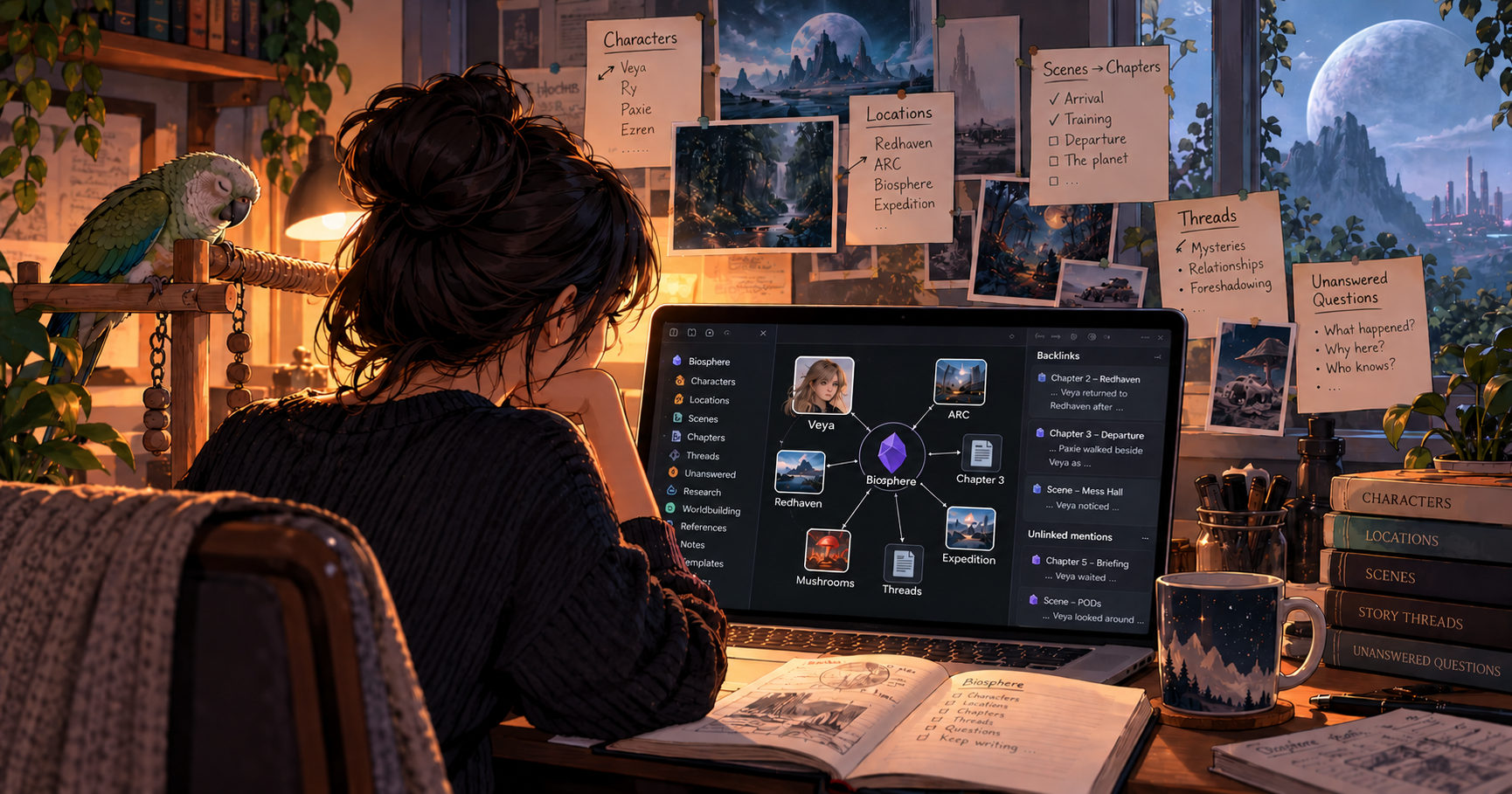
With that said, I cleaned up the C05 workstation, pulled together all the scattered, unorganized notes that had been piling up, and started incorporating them into the outline database in Notion. Not glamorous work, but without it, everything downstream gets harder.
Session 2: Working Through the Chat that Started it All
Session two was where things got more interesting. I started working through the original chat document — a 293 page, ~68,000-word AI brainstorming session that contains a huge amount of raw material for this project.
The goal is to go through it systematically: keep what’s still important, let go of what isn’t, and refresh my memory on the older foundational stuff that should still be useful.
Essentially, distill it into something lean & essential.
I am now down to 64,000 words, which is still roughly the length of a full novel. Except instead of a finished story, it’s a dense tangle of ideas, worldbuilding threads, character concepts, and half-developed plot lines — and the job is to find the gold in there.
It’s a satisfying way to work, honestly. The number going down isn’t just a metric — it means the noise is being separated from the signal. Each page cut is a decision made, a thread evaluated, a piece of the story either locked in or let go. By the end, what’s left should be close to a real foundation.
What’s Coming Next:
The reason I’m working this way is simple: I don’t want to lose anything. A lot of the best ideas in a project like this emerge sideways — in the middle of explaining something else, in an offhand aside. Skimming and trying to remember the highlights isn’t good enough. Slow and methodical is the right call here.
The current task list is as follows:
- Work through the AI chat session chunk by chunk. I do this by exporting it into a Google Doc so I can edit, annotate, and highlight directly. Since I’m trimming a lot down, I’ll create a new version every so often — keeping old data around in case I need to revert or go down a different path later on.
- Extract the relevant information and fold it into the growing Notion database.
- Once the chat has been fully processed, move it into a dedicated “Biosphere — transferred” folder. That way I always know what’s been accounted for and what hasn’t. One of the biggest risks with a project this sprawling is losing track of what you’ve already thought through. Having a clear visual signal that a document has been processed removes a lot of mental overhead.
Beyond the current chat, there’s a whole other layer of source material to get through: a collection of ChatGPT conversations about Biosphere that I haven’t touched yet. All of those will go through the same workflow.
THE BIGGER PICTURE
The end goal of all this organizational work isn’t the organization itself — it’s a solid enough foundation that I can actually start drafting again with confidence. Right now, the ideas exist, but they’re scattered. The Notion database and the outline are how I turn a pile of raw material into something I can actually draft from.
More updates soon. This is a slow build, but the foundation is taking shape, and that matters more than speed.
![Book Summary: The Devil and the Dark Water [FULL SPOILERS]](https://gwuwi.com/wp-content/uploads/2026/10/The-Devil-and-the-Dark-Waters.png)






Leave a Reply