

This study is empirical support for the claim that switching strategies is beneficial—but only under the right conditions.
The question the researchers asked:
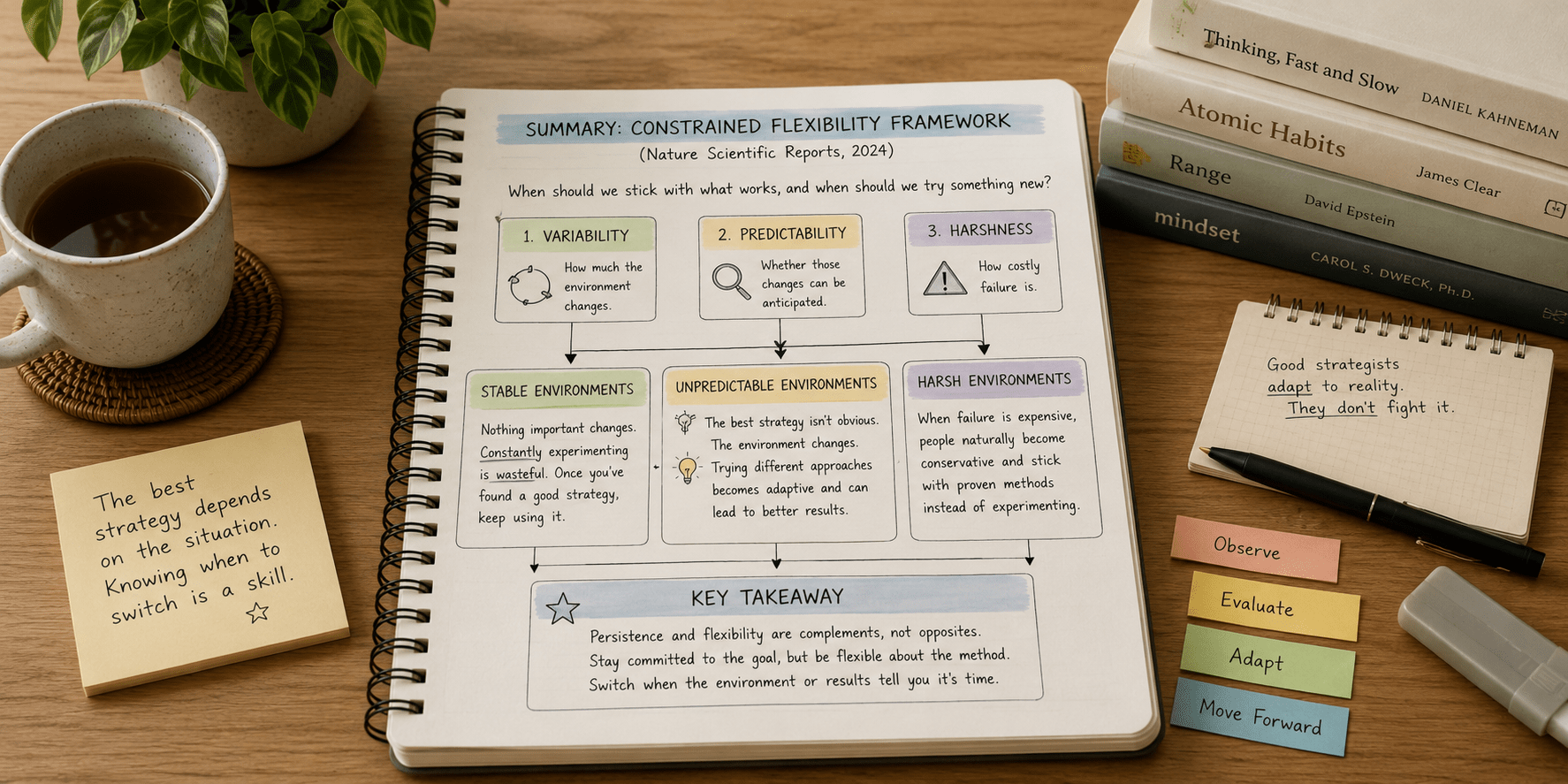
When should we stick with what works, and when should we try something new?
Humans are capable of being incredibly flexible, yet we also tend to stick with familiar methods even when better ones exist. What are the conditions under which each type of behavior is produced?
The Constrained Flexibility Framework (CFF)
The paper proposes that strategy switching depends on three environmental factors:
- Variability – How much the environment changes.
- Predictability – Whether those changes can be anticipated.
- Harshness – How costly failure is.
The framework argues that flexibility is not inherently good or bad.
Instead, the best amount of flexibility depends on your situation.
Stable environments → Stay with what works
Imagine:
- brushing your teeth
- following a recipe you’ve perfected
- driving the same commute every day
Nothing important changes.
The researchers argue that constantly experimenting here is wasteful.
Once you’ve found a good strategy:
Keep using it.
Switching just creates unnecessary effort.
Unpredictable environments → Experiment more
Now imagine:
- organizing a cluttered home
- starting a new business
- writing creatively
- solving a difficult problem
The “best” strategy isn’t obvious.
The environment changes.
In these situations the researchers argue that trying different approaches becomes adaptive.
If one method stops producing progress, exploring another may uncover something better.
Harsh environments reduce flexibility
This was probably the most interesting finding.
When failure became expensive, participants became much less willing to experiment.
Examples:
- your job depends on success
- mistakes cost lots of money
- failure carries serious consequences
People naturally become conservative.
They keep using proven methods instead of exploring alternatives.
Quick Reference Summary:
How they tested it
Researchers recruited 299 adults across two studies.
Participants repeatedly chose among four options (“jars”) that produced rewards.
Sometimes:
- one jar stayed consistently best (stable environment)
Other times:
- which jar was best kept changing (variable environment)
They also manipulated how “harsh” mistakes felt by increasing the consequences of poor choices, including adding real monetary incentives in the second study.
What they found
Their results largely matched the theory.
Participants:
- experimented more in changing environments
- experimented less when mistakes were costly
- relied on proven strategies when environments were stable or high-risk
What this means for everyday life
One of the biggest takeaways is that persistence and flexibility are complements, not opposites.
Good decision-makers don’t blindly persist.
They also don’t constantly chase new methods.
Instead they ask:
Has the environment changed enough that my current strategy no longer fits?
If yes:
- try something different.
If no:
- keep using what already works.
Mailing List
Come Wonder With Me
This notebook is an ongoing exploration of writing, creativity, human behavior, faith, science, and whatever else captures my curiosity.
Every article begins with a question I can’t stop thinking about.
If you’d like those questions—and whatever answers I manage to uncover—delivered to your inbox, subscribe below.
![Book Summary: The Devil and the Dark Water [FULL SPOILERS]](https://gwuwi.com/wp-content/uploads/2026/10/The-Devil-and-the-Dark-Waters.png)







Leave a Reply