
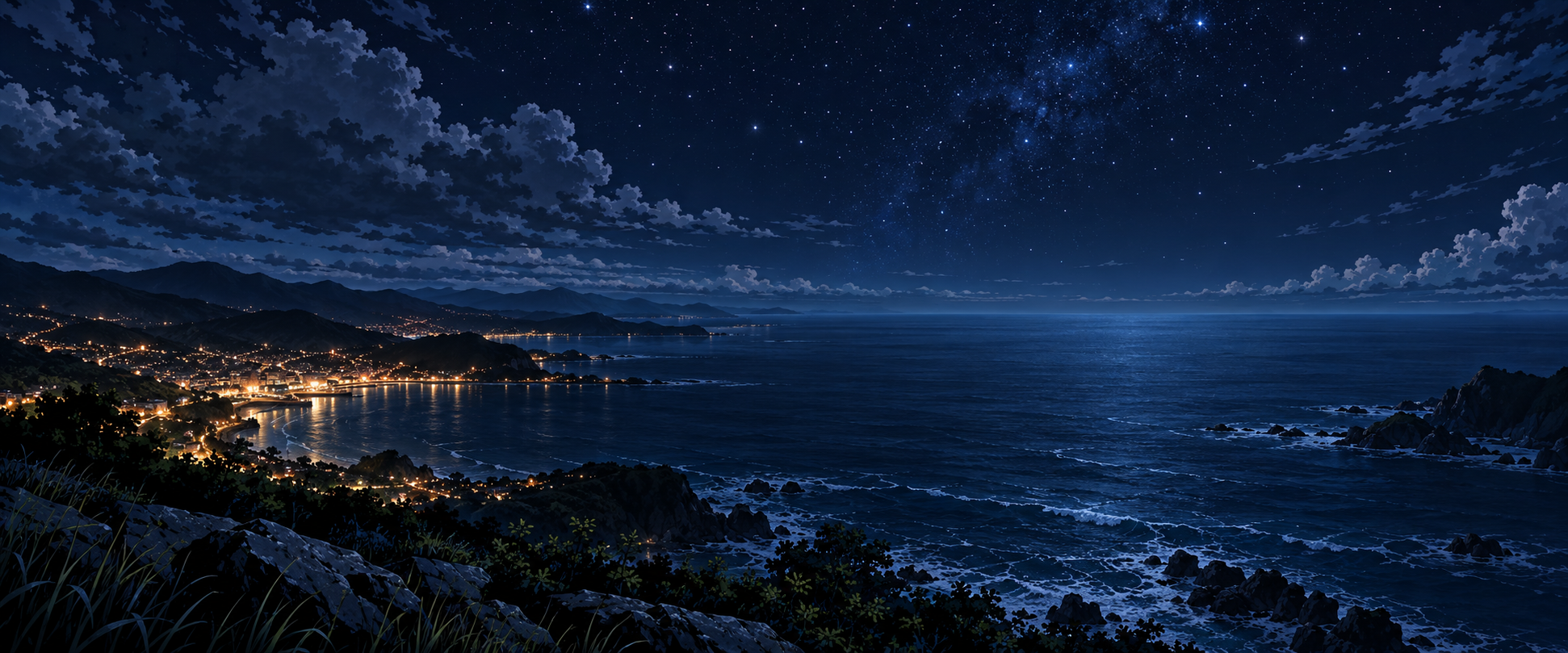
Assume the Moon simply vanishes instantly—no explosion, debris, or magical energy release. The effects would unfold on wildly different timescales.
🌑The first few seconds
Nothing.
We wouldn’t even know yet. The Moon is about 1.28 light-seconds away, so we’d continue seeing it for roughly 1.3 seconds after it disappeared.
Then: gone.
If it happened during the night, the sky would become dramatically darker. A full Moon can make the landscape easily visible; without it, genuinely dark locations would have only starlight, planets, airglow, and artificial light.
And we’d never see a solar or lunar eclipse again.
🌊 Within hours: the oceans would change
This is probably the first major physical consequence we’d notice.
The Moon is the dominant contributor to Earth’s tides. The Sun also creates tides, so the oceans wouldn’t become tideless—but lunar tides would disappear.
The familiar cycle of spring and neap tides produced by the changing alignment of the Sun, Earth and Moon would disappear too. We’d be left with much weaker solar-driven tides.
That would affect tidal flats, estuaries, mangroves and countless organisms whose lives are synchronized with tides.
🐢 Then things get weird for animals
The Moon is effectively a giant biological clock.
Corals can synchronize spawning with lunar cycles. Sea turtles use environmental cues including moonlight when navigating toward the ocean. Some predators alter hunting depending on lunar illumination. Zooplankton, fish, insects and other organisms exhibit lunar or tidal rhythms.
Removing the move would remove an environmental signal that life has been evolving around for billions of years.
Some species would adapt. Some ecological relationships would probably shift dramatically. Particularly specialized tidal organisms could have a much harder time.
🌍 But Earth wouldn’t fly out of orbit
This is where the scenario is less apocalyptic than it sounds.
Earth would continue orbiting the Sun.
The Moon’s gravity affects Earth, but the Sun overwhelmingly determines Earth’s orbit. Removing the Moon doesn’t suddenly send us hurtling through space.
Our day wouldn’t suddenly change dramatically, either. The Moon has been gradually slowing Earth’s rotation through tidal friction—but that’s a process operating over enormous spans of time.
Removing the Moon would essentially stop most of that lunar braking.
So the consequences become much more interesting when you ask…
🧭 What happens over millions of years?
The Moon helps stabilize Earth’s axial tilt.
Right now Earth is tilted about 23.4°, which gives us our seasons. That tilt naturally varies, but the Moon’s gravitational influence helps keep those variations relatively constrained.
Without the Moon, Earth’s tilt could potentially become substantially more chaotic over very long periods.
That doesn’t mean:
Moon disappears → Earth flips sideways.
It means that over millions of years, Earth’s orientation could undergo larger variations than it does today.
And that could radically alter climate.
Imagine Earth’s tilt eventually becoming much larger. Summers at high latitudes could become extraordinarily intense. Seasonal patterns could shift. Ice sheets could advance or retreat differently. Ecosystems would migrate.
Earth would still be habitable, but its long-term climate might become considerably less stable.
🌊 And there’s an incredible historical twist
If you’re asking “Would humanity survive if the Moon vanished tomorrow?”
Probably.
Civilization would face ecological disruptions, altered coastal systems, changes to navigation and animal behavior, and some seriously confused astronomers.
But let’s explore: would humans exist if Earth had never had a Moon?
The ancient Moon produced much stronger tides because it was considerably closer to Earth. Those enormous tidal environments may have influenced the environments in which early life evolved. The Moon also altered Earth’s rotation and long-term planetary dynamics.
So remove the Moon tomorrow and humanity probably survives.
Remove it 4.5 billion years ago, and you potentially rerun Earth’s entire evolutionary history.
Maybe intelligent life still appears. Maybe complex life develops completely differently. Maybe nothing resembling us ever walks onto land.
🌕 The Moon is doing more than lighting the night
The strange thing about imagining a world without the Moon is realizing how much it’s doing while seemingly doing nothing at all. It pulls at our oceans. It provides a clock for wildlife. It influences Earth’s rotation and helps stabilize the planet’s tilt. Its presence has shaped the environment in which life evolved for billions of years.
If the Moon disappeared tonight, we’d notice the darkness first. Then, thousands of years from now, people would know moonlight only from old photographs and stories. A “moonlit walk” would describe an experience no living person would ever know.
The biggest changes would take much longer to reveal themselves. Future civilizations would eventually encounter seasonal and climatic patterns unlike anything in recorded human history. Regions that had been temperate for millennia could experience much more extreme summers or winters. Ice sheets could expand or retreat, ecosystems could migrate across continents, and agriculture would have to follow the moving boundaries of habitable climate.
If the Moon disappeared in an instant, Earth would spend millions of years adjusting to its absence—and the planet at the end of that transformation would be very different from the one we know today.
![Book Summary: The Devil and the Dark Water [FULL SPOILERS]](https://gwuwi.com/wp-content/uploads/2026/10/The-Devil-and-the-Dark-Waters.png)




Leave a Reply