
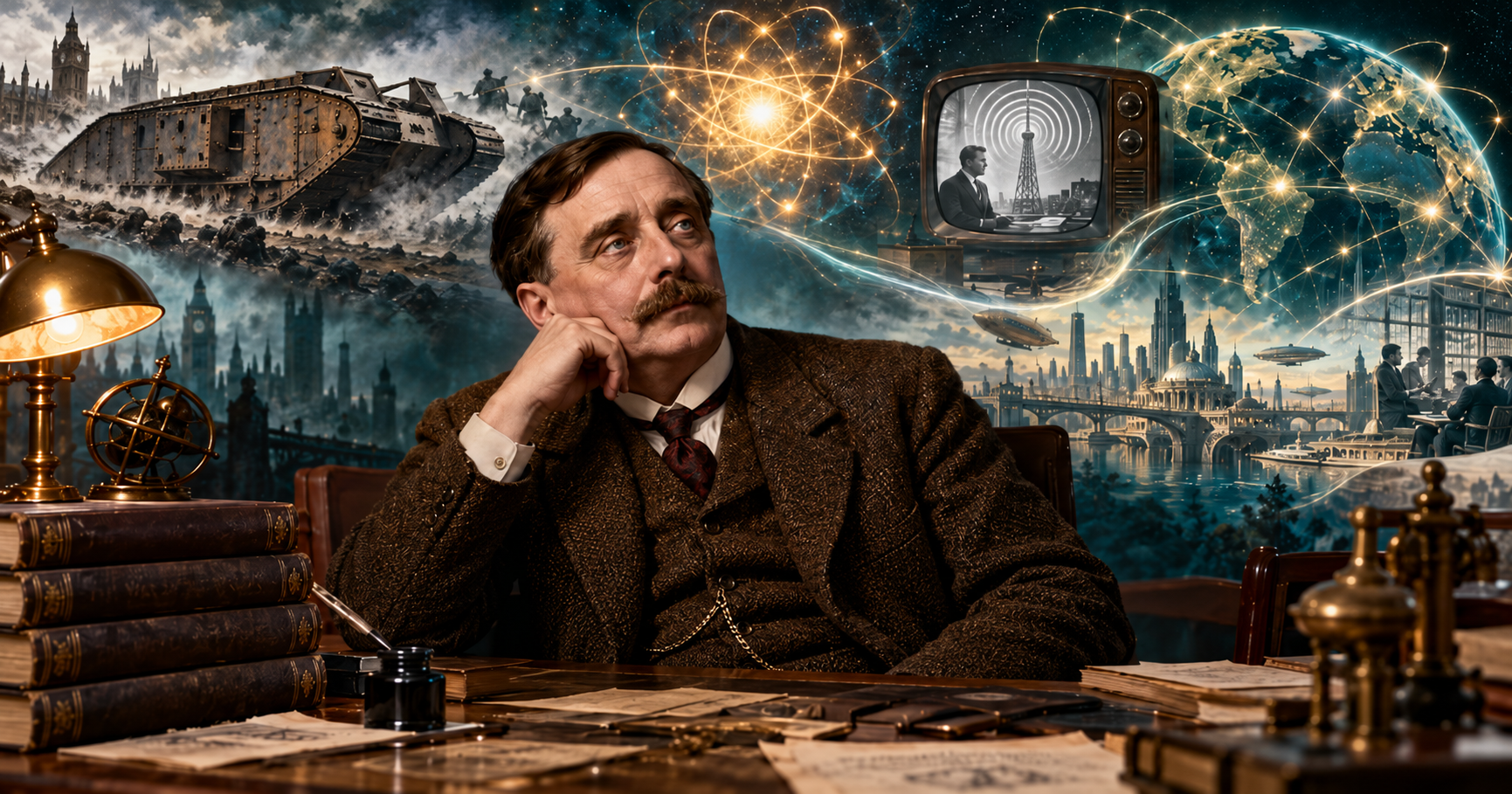
Imagine writing a science fiction story about a machine that could destroy entire cities, decades before anyone had built an atomic bomb. Or imagining a world where information could be collected and made accessible to people everywhere, long before the internet.
That was the remarkable imagination of H.G. Wells.
Best known for The Time Machine, The War of the Worlds, and The Invisible Man, Wells was one of the pioneers of modern science fiction. But some of his most fascinating ideas concerned technologies that would eventually become reality.
So how did a Victorian-era writer manage to imagine inventions so far ahead of his time?
1. Atomic Bombs — The World Set Free (1914)
In 1914, Wells published The World Set Free, a novel that imagined a future in which scientists discovered how to release enormous quantities of energy from atoms.
In his story, this discovery led to the creation of atomic bombs capable of devastating cities.
At the time, scientists were only beginning to understand radioactivity and the energy contained within atoms. Wells drew inspiration from this research and imagined what might happen if humanity learned to harness that energy.
Thirty-one years later, in 1945, the first atomic bomb was detonated during the Trinity test in New Mexico. Atomic bombs were subsequently dropped on Hiroshima and Nagasaki.
Wells had imagined atomic warfare decades before it became reality.
His fictional bombs worked differently from actual nuclear weapons, but the underlying possibility of releasing devastating energy from atoms was remarkably prescient.
2. Tanks — The Land Ironclads (1903)
In 1903, Wells published a short story called The Land Ironclads.
The story featured enormous armoured vehicles capable of moving across difficult terrain while protecting the soldiers inside them. These machines could advance against enemy positions, fundamentally changing the nature of warfare.
More than a decade later, tanks made their battlefield debut during the First World War in 1916.
Although Wells’s fictional vehicles were different from modern tanks, their resemblance was striking.
Wells himself later reflected on the similarity between his imaginary machines and the real tanks that appeared during the war. He also acknowledged that his idea had been inspired by existing mechanical developments.
This reveals something interesting about his imagination: he often took technologies already emerging in his own time and considered what they might eventually become.
3. Television and Audiobooks — When the Sleeper Wakes (1899)
In When the Sleeper Wakes, Wells tells the story of a man who falls into a mysterious sleep and awakens more than two centuries later.
The future he encounters is filled with extraordinary technology.
There are towering skyscrapers, moving roadways, flying machines, and forms of entertainment that resemble television and audiobooks.
Today, watching moving pictures on a screen or listening to someone narrate a book seems perfectly ordinary. But in 1899, television broadcasting had yet to exist, and recorded audio was still a developing technology.
Wells imagined how these inventions might evolve and become part of everyday life.
What makes this particularly interesting is that he envisioned more than individual machines. He imagined an entire society transformed by technology, including how people travelled, consumed entertainment, and interacted with the world around them.
4. A Worldwide Knowledge Network — World Brain (1938)
Perhaps one of Wells’s most intriguing ideas was his vision of a global collection of human knowledge.
In World Brain, published in 1938, Wells proposed creating a continuously updated world encyclopaedia that would make reliable knowledge widely accessible.
He believed humanity would benefit from a system that organized information and allowed people to learn from the collective knowledge of civilization.
The concept bears a striking resemblance to modern online encyclopaedias such as Wikipedia.
Wells was imagining a coordinated, accessible system of information decades before the World Wide Web existed.
His proposed encyclopaedia was different from the internet as we know it today, but the ambition was familiar: make human knowledge easier to find, share, and use.
How Did H.G. Wells Predict the Future?
Wells’s ideas might seem almost prophetic, but his imagination was grounded in scientific curiosity.
Before becoming a novelist, he had won a scholarship to London’s Normal School of Science in 1884, where he studied biology under Thomas Henry Huxley, a prominent supporter of Charles Darwin’s theory of evolution. Wells later became a science teacher and even published his own biology textbook.
He also kept up with scientific discoveries through reading. For example, his novel The World Set Free, which imagined atomic bombs decades before their invention, was inspired by Frederick Soddy’s 1909 book The Interpretation of Radium. Wells took what scientists were discovering about atomic energy and imagined what humanity might eventually do with it.
His approach was surprisingly straightforward: understand the science, consider its possibilities, and imagine what might happen next.
If scientists could release energy from radioactive materials, what might that mean for warfare?
If mechanical vehicles became more powerful, how might armies use them?
If information and communication technologies continued improving, how might people access knowledge in the future?
Wells explored these questions through stories.
Of course, many of his imagined futures never materialized.
Future Predictions That Have Not Materialized
Wells imagined quite a few futures that haven’t (yet?) materialized. Some are wonderfully bizarre!
- Anti-gravity materials — The First Men in the Moon (1901): Wells invented a substance called Cavorite that could block gravity, allowing a spacecraft to travel to the Moon. No such substance has ever been discovered. Wikipedia
- Civilizations beneath the Moon — The First Men in the Moon (1901): He imagined an advanced society of insect-like creatures called Selenites living inside the Moon. We have found no evidence of such a civilization. Project Gutenberg
- A permanent world government — The World Set Free (1914): Wells envisioned atomic warfare eventually convincing humanity to establish a unified global government and a peaceful civilization. That future hasn’t materialized. MIT Press
- Moving roads — When the Sleeper Wakes (1899): Wells imagined cities with enormous moving roadways transporting people around. Although moving walkways exist in airports and other buildings, entire cities haven’t adopted his vision. H.G. Wells
- Humanity evolving into two separate species — The Time Machine (1895): Wells imagined humanity eventually splitting into the delicate, surface-dwelling Eloi and the underground Morlocks. His story is set hundreds of thousands of years into the future, so this remains fictional speculation rather than a failed prediction.
Some of these ideas remain firmly in the realm of science fiction, while others may simply belong to a future we haven’t reached.
His predictions were speculative, and he was among many thinkers exploring the possibilities of technological progress.
What Set H.G. Wells Apart?
If he was one of many thinkers, what set him apart? Why did he become so successful and well known?
It was his ability to turn scientific possibilities into compelling stories about humanity. Other thinkers imagined new technologies, but Wells explored what those inventions might do to civilization and the people living in it.
Several qualities helped make his stories both popular and enduring:
- He made complex scientific ideas accessible. Readers didn’t need a scientific education to enjoy his stories. He introduced extraordinary concepts through adventure, suspense, and recognizable characters.
- He explored the consequences of technology. In The Time Machine, he used the distant future to examine class divisions. In The War of the Worlds, he imagined humanity confronting a technologically superior civilization. His stories raised questions about human nature, power, and progress.
- He made the extraordinary feel believable. Wells often placed impossible events in familiar English settings, grounding them in recognizable places and everyday reactions. This helped readers imagine that his fictional events could actually happen.
- He was remarkably prolific. After The Time Machine became a success in 1895, he published The Island of Doctor Moreau (1896), The Invisible Man (1897), and The War of the Worlds (1898). His steady output helped establish his reputation.
- His ideas were influential. Time machines, alien invasions, and scientific experiments gone wrong became enduring elements of science fiction. Later writers drew inspiration from his work, helping his influence extend beyond his lifetime.
The Power of Asking “What If?”
What makes H.G. Wells fascinating is how he used scientific knowledge as a starting point for imagination.
He observed the discoveries happening around him, considered their possibilities, and followed those possibilities into the future.
Sometimes his imagination led him to terrifying conclusions, as with atomic weapons. Other times, it led him toward hopeful ideas about education and shared knowledge.
His work reminds us that science fiction can do something extraordinary: encourage us to imagine where the world might be heading.
And occasionally, the future catches up with the fiction.
Free Copies of His Books
Wells died in 1946, and so his original writings are generally public domain in Canada. Meaning, you can get free copies of his work online. (Note: modern introductions, annotations, and adaptations can have separate copyright protection.)
Books Referenced in this Article
| Book | Published | Free copy |
|---|---|---|
| The World Set Free — Atomic bombs | 1914 | Read free |
| When the Sleeper Wakes — Futuristic cities and technology | 1899 | Read free |
| The First Men in the Moon — Anti-gravity and lunar civilization | 1901 | Read free |
| The Time Machine — Time travel and human evolution | 1895 | Read free |
| The War of the Worlds — Alien invasion | 1898 | Read free |
| The Invisible Man — A scientist discovers how to become invisible. | 1897 | Read free |
| The Island of Doctor Moreau — A scientist conducts disturbing experiments on animals. | 1896 | Read free |
Other H.G. Wells books worth exploring
- Anticipations (1901) — Wells’s nonfiction predictions about transportation, warfare, technology, and society.
- War and the Future (1917) — Includes Wells’s reflections on tanks and their resemblance to his fictional land ironclads.
You can also browse H.G. Wells’s full Project Gutenberg catalogue.
I’d particularly recommend reading The World Set Free and Anticipations. They give you a chance to see how Wells developed his ideas in his own words.
Kindle Edition on Sale
At the time of writing this post, the kindle edition is on sale right now at 93% off for $0.99:

Mailing List
Come Wonder With Me
This notebook is an ongoing exploration of writing, creativity, human behavior, faith, science, and whatever else captures my curiosity.
Every article begins with a question I can’t stop thinking about.
If you’d like those questions—and whatever answers I manage to uncover—delivered to your inbox, subscribe below.
![Book Summary: The Devil and the Dark Water [FULL SPOILERS]](https://gwuwi.com/wp-content/uploads/2026/10/The-Devil-and-the-Dark-Waters.png)






Leave a Reply