

If you haven’t already and you want to start from the beginning: read Chapter 1 here & if you’re curious: read the story summary here.
The rodent had wedged itself between the lower rail and the support post sometime in the night, and by the time Veya reached Range 14, it had stopped struggling.
She dropped to her knees on the red soil without thinking. It was a kaelie rat. Young, maybe four months old, its hind leg twisted at an angle that had made her draw in a breath and forget to release it. The rodent watched her with the flat, glassy terror of something that had exhausted every other option.

“Alright,” she said quietly. Not to calm it, just to mark the moment.
She worked slowly, hands steady, one palm flat against its flank while the other guided the leg free of the gap. The kaelie went still. She felt its heartbeat against her fingers. Fast, perhaps too fast, but there. She set it on the ground and it didn’t run, just sat trembling in the shadow of the fence post, watching her.
Veya sat back on her heels and watched it back, giving it a small smile. Maybe it understood what a smile meant, maybe it didn’t. A smile was the only way she knew how to comfort it aside from keeping her distance. Keeping a good distance was universal code for safety across all animal languages.
Her armband pulsed against her wrist.
“Hey.” Trevor’s voice came through her connected earbuds, low and barely containing itself. “You still at the Range?”
The kaelie rat didn’t flinch. Veya kept her eyes on it. “Yeah. Why?”
A beat. She could almost hear him grinning through the earpiece. “They have a Ferox.”
Veya went very still. The kaelie rat continued to tremble in the shadow of the fence post, oblivious to everything.
“Since when?” She kept her voice flat so he wouldn’t hear how fast her pulse was moving.
“Transported three hours ago. Entry ballots are filling fast, I think there might even be a fight tonight — Sera can probably still get you in, but you’ll need to leave soon. I can meet you at the homestead, Chief’s almost done here, we’ll both be back there soon.”
She looked at the kaelie. Still frozen. Still not ready.
“Alright, I’m heading back,” she said. “Just give me a few minutes.”
She clicked off and turned back to the animal. “No pressure,” she told it quietly.
She hoped it felt better. She should have been on the road back an hour ago. Her pack was already loaded at the homestead. The colony transport window didn’t stretch for stragglers. But she had this inability to leave things half-finished. She gave the kaelie another minute, then stood and turned her attention to the fence.
The post had sheared at the base — old corrosion, the kind that came from years of red season’s salts and grit working into every seam. She didn’t have the right tools for a permanent fix, but she had wire and a spare bracket. She worked without rushing, hands moving through motions she’d done so many times that the actions barely required thought.
When she finished, she pressed her palm flat against the post. Solid. Not perfect, but sturdy enough. The kaelie had gone by then. It was for the best, she told herself. She would have taken it home if it hadn’t gathered itself by the time she had finished. And since she wouldn’t be around much longer to see its rehabilitation through to the end, Verada Talia, her godmother, would have had another task to manage, another mouth to answer for.
Veya gathered her tools and didn’t let herself look back at the range as she walked away. That was the trick she’d learned over years of tending to the property: don’t look back, or you’ll find another reason to stay.
The homestead felt different when she stepped inside.

She’d been gone less than two hours, but the quality of the silence had shifted — become more heavy, like it had settled in for a longer visit while she was out. Her pack sat by the door. The table held the remnants of a breakfast she hadn’t been hungry enough to finish. Everything was exactly as she’d left it, not even one of the farmhands had come in yet, which was odd. At the very least, Trevor usually liked helping himself to something in the fridge before he started the day.
She stood in the entryway for a moment, hesitating. Then walked down the short corridor to Arden’s room.
She didn’t know what she expected. She’d been in there only a handful of times since her brother had left, all of them for practical reasons — once to check his equipment shelf for something that was needed for repairs, once to close the window she’d heard rattling in the night, and another time to chase a veln out. Small hollow-boned fliers, drawn to warmth and enclosed spaces, more a nuisance than a threat.
Each time, she’d been efficient. In and out. Allowing herself nothing, no additional time to linger.
This time she just stood in the doorway.
His room was tidy the way his rooms always were — not clean exactly, but organized according to a logic that was entirely his own. Tools sorted by use rather than type. Books stacked horizontally because he thought vertical stacking warped the spines. A faded topography map of Redhaven’s southern basin pinned above his desk with four careful tacks, one at each corner.
She’d never told him she found that map comforting. Something about the way it reduced everything to lines and contours and grids — the southern basin made legible, holdable. The world as a thing that could be known.
She hadn’t told him a lot of things because it had felt like there would always be more time. More mornings where they fought over who got to use the bathroom first. More evenings where they sat on the back step and talked about nothing while the red dust settled over every surface and the double moons came up slow above the ridge. She had stored those moments carelessly, the way you store things you believe were inexhaustible.
Veya crossed to the desk and opened the small drawer where she had previously placed his necklace. The one he had always worn. It had come back with the rest of his personal effects two years ago. Verada had given it to her along with a note that came with it. Her name, written in unfamiliar handwriting.
She stared at it.
A simple chain, silver that had never warmed with age, still bright in a way that she couldn’t account for. The pendant on it was a flat hexagon, roughly the size of two thumbnails. Its face was etched with diagonal lines, running corner to corner and at times turning or branching from its originating line. One caught the light differently from the rest, a thin strip that seemed to almost glow depending on how it was angled.
Growing up, she had never seen him without it. And she never thought to question it. Never once touched it, never wanted to take a closer look. Just accepted that it was a part of him.
In the days after Verada had handed it to her, she had examined it over a hundred times. There were coordinates etched on the back in Arden’s handwriting. Small and precise, nothing like the rest of him. They were in the same code he had trained her to decipher as a child. A code no one else understood except for them.
Before he began her training on it, he had sworn her to secrecy, on the lives of their parents, that she was to tell no one. Not even their Verada. Though she wasn’t sure her parents were alive—but because Arden believed in their continued existence—she had taken the oath with all the gravity a seven-year-old could muster, which, for her, had been quite considerable.
Then, before she could ask about their parents, he had proceeded to draw out various coordinates for her to decipher. Originally they had started on the sands near the water, where the markings would wash away before anyone else could see them. The impermanence was the point. It forced her to identify the patterns fast, to hold them in her mind rather than on any surface. And for every location she correctly identified, he left a reward waiting — a small creature she could bring home after a long day of drills, hers to nurse and shelter and train or release back to the plains. Whatever she chose. Everyone on the farm had a talent to foster. Hers was tending to animals.
“But why, Arden?” Veya had asked once, while a selk nuzzled her neck. Soft and gentle and fluffy, she petted it and gave it the thing it was really after, a piece of whiteroot just out of its reach.
Arden shrugged. “Mom wanted me to teach you. It’s how we always found each other if we were ever separated.”
Veya’s eyes widened. She had heard the stories of how Arden and their mother was separated from their father at times when they were on their “travels”. This was before Veya was born. Verada, who was their mother’s closest friend, had said their mother would always have this uncanny ability to find their father again. Arden never spoken on it when Verada mentioned it. Having gone through many code drills now, realization finally dawned on Veya of this being the reason her parents managed to stay connected despite the long distances.
“There were always certain places she would look,” Arden said, thoughtfully. “Corners, or points where three things met in one location. That was if we were in civilization. In the wild it was harder — beneath medium stones, set apart from where you’d naturally find others of its kind. Tree barks were best though. Where branches met. Cacti work too, but they’re miserable to write on.” He paused. “If I ever leave anything for you, I’ll try to make it an obvious sign. But it won’t be exactly where the sign is, okay? You’re going to have to look around the area for a bit.”
Veya had nodded solemnly and looked out toward the distance, mindlessly petting the selk. When it hopped away after a piece of corn, she reached over and picked up the scribe tool Arden had used to etch that day’s coordinates. Several months into her training by then, they had graduated to writing the codes in actual locations, erased before nightfall. They had gone back to scratch out that day’s set with a scribe setting high enough that Arden wouldn’t allow her to touch. She had waited until he was busy rearranging the stones back to their original places before she snuck in a blast. He had almost dropped one on his feet. While normally even tempered, something about it being a particularly hot day during the Red Season and her poor attempt at stifling her laughter made him chase all the way back to the homestead, both of them laughing.
Veya smiled at the memory as she felt the markings Arden had etched into the necklace’s metal under her finger.
∆ R9 · >> 2 T
The location must have meant something to him. The fact that it ended with a T told her it was not on this planet, but on the Biosphere.
Thalyss.
The only planet in their cluster of colony planets that sustained any real life. The one every colony relied on for resources. It had ample fauna and flora for food. Fresh water that sometimes didn’t need processing. An abundance of raw materials—fibrous, mineral, organic—that replaced entire supply chains and re-assigned manufacturing facilities. And beneath it all, new elements that proved to be stable, renewable energy sources. Powerful enough to change how energy worked across the colonies and all its fleets.
Thaylss was the reason the colonies were still alive.
And yet, nothing turned on them the way it could.
Storms formed without warning, as if the sky chose a point and collapsed around it. Terrain shifted—paths closed, new growth swallowed entire clearings overnight. Creatures watched, learned, adapted faster than they should. Expeditions that went quiet with no wreckage, no signal, nothing left behind but coordinates that led nowhere.
Official reports called it environmental instability. No one who had been there believed that. People talked about it in the colony bars when their supervisors weren’t around. About what the corporations were really doing out there. About the creatures that came out wrong. About experiments that turned men into something else. Hybrids, rumors called them. Veya didn’t believe the rumors, but she did believe Arden when he told her the Biosphere was more dangerous than anyone admitted.
Those who hadn’t been there but heard the whispers, spread them far enough to create a ripple of unspoken foreboding across every planet in the cluster.
Thaylss wasn’t just resource rich, it was a risk the colonies couldn’t afford to stop taking.
And so the marketing campaigns for recruitment into the Expeditionary Corps (ECs) continued to dominate interplanetary media, fueled by what seemed to be unlimited government funds, at least when it came to this particular agenda. For other initiatives like creating more sustainable environments on the colonies themselves, the limit was suddenly very apparent. Which was odd, because Veya saw them as two sides of the same coin. Building something sustainable in each of the colonies would help them become more self-reliant and reduce their dependence on Thalyss. Many who shared that view believed it came down to corporate greed. The ECs profited too well from the harvests to want the colonies self-sufficient. Casualties were simply the cost of doing business.
When the numbers of new recruits dwindled, drafting initiatives ensured the corporate ventures remained well stocked with human resources.
Resources to extract resources.
It was during one of those drafts that they came for Veya. They’d flagged her work with animals, cited it as useful, despite her youth. Arden had been there when they came and didn’t hesitate. She still didn’t know what he’d said to them. Only that when they left, it was his name on the manifest that replaced hers.
A decision that both haunts and frustrates her to this day.
She picked up the necklace.
Arden didn’t leave things without purpose. He left things to be found. The chain pooled into her palm. She turned the pendant over and read the coordinates again, though she’d long since memorized them.
∆ R9 · >> 2 T
She stood there long enough for the light through the narrow window to shift half an inch along the floor. Then, finally having decided, she reached back and fastened the chain around her neck. The pendant settled against her sternum, just below the collar of her shirt, and she pressed two fingers over it briefly — a gesture that just happened instinctively, something she’d seen Arden do countless times before.
She heard the main door open and close and a familiar voice call out, “Veya?”
She made her way back to the common area. “Hi Verada.”
Her godmother looked exactly the same as she always did on her days off from the colony’s Infrastructure and Research Division—dark hair tied back, sleeves rolled to the elbows, grease still streaked across her hands from whatever equipment she’d been repairing on their property. She looked up when Veya entered and for a moment said nothing, just took her in.
Trevor, the farmhand who could have been her Verada’s protégé and might just end up being if Veya knew her godmother, shuffled his feet. He lingered near the door with the energy of someone who could sense the weight in a room and didn’t know what to do with it.
“All packed?” Verada said finally.
Veya nodded.
“Are you going to the cemetry?
“I always do before a big decision,” Veya said.
“The decision was made a long time ago,” Verada’s voice was not unkind. “You’re in execution phase, my girl. Or are you having second thoughts?”
Veya looked at her. “No. I just want to say goodbye.”
Verada nodded. “I’m hearing news that the Helio Run has been delayed by several hours as they work to consolidate the flight with some recruits from Glacierreach. When will you be back?”
It was Trevor who answered. “In a couple of hours, maybe.” Both of them looked at him. He smiled, undeterred. “If you don’t mind, Chief Talia — some people would like to say goodbye to Miss Veya.”
Verada raised both eyebrows. “I didn’t realize my introverted goddaughter who prefers the company of animals to humans had friends.”
Veya felt her jaw drop. “I have friends.”
Verada’s eyebrows knitted. They were putting in overtime today. “Name one.”
Veya thought for a second before blurting out the first name that came to mind, “Sera.”
Trevor looked panicked. Veya realized her mistake, but maintained eye contact.
Verada’s brow furrowed. “Sera.” A pause, and then, “The woman who drops off our animal feed.”
“…We talk.”
“…About price lists?”
“She always stays to help unload.”
“That’s her job.”
Trevor intervened, “Chief, what I meant to say was, I have to show Miss Veya something, and then we’ll be back in no time.”
Trevor grabbed Veya by the shoulders and steered her out before either of them could object. The door had barely closed behind them when he dropped his voice into a loud whisper. “It’s confirmed—they’re gonna have a fight tonight.”
Veya’s head whipped toward him. “That’s fast.”
“Yeah, well, it’s hungry.” Trevor shrugged.
“They’re actually starving a Ferox. A Ferox of all things?”
Trevor grinned. “Yeah, they never do that with the herbivores for some reason.”
Veya rolled her eyes. She was never a big fan of the ring. She felt it was cruelty to animals. But she couldn’t determine a way to dismantle it permanently. Though it was not for lack of trying.
She had gotten into quite a bit of trouble in her early years when she managed to successfully sabotage it. Some of the animals she had set free still roam out in the deserts. Whatever that could survive anyway. Two were rescued by Talia and still live on the farm to this day. The others were killed or recaptured. Something she could never forgive the colony for.
Though no one could prove it was her, Arden seemed to have an inkling. But the ‘trouble’ she had gotten into wasn’t really the consequences dealt out by the colony. It was from the animals themselves.
When releasing them, two of the raptors had cornered her and sunk their teeth into her thigh — not for the kill, just to drag her closer. Not that being up close and personal with a raptor was much better, but considering the alternatives, it could have been worse. At least it hadn’t broken bone. Those were painful to regrow.
Thankfully, one of the rangers had managed to get to her in time.
After that ‘fiasco’, the ring was back up and running within 14 days. It had grown too big to be taken down for long.
Arden, looked at her wearily after that during one of her usual rants about the injustice of it all. But instead of dissuading her, he seemed to now accept that she was going to persist with her efforts and encouraged her to use it instead.
She had frowned up at him while he turned his attention to the engine of the crawler. “What do you mean?”
He shrugged. “Doesn’t hurt to be prepared.”
“For what? There are no animals here except the ones we bring. And we seem to only bring them to hurt them.”
“Well should any more of them get free again,” he looked at her and she tried her best to keep from looking contrite as he continued, “Knowing how to interact with them could help you know how to help them.”
Her eyes blazed again. “Interact? By fighting them in the ring? Like what you do? Why do you even do it? It’s barbaric!”
“Whoa, retract your claws, bear cub. No, I don’t want you fighting in there. Just watching. You’re good at noticing things, Veya. It’ll help you learn how to stay alive when you’re out there, where you love to be. When the animals are the ones fighting you because they don’t understand you’re out there trying to help them.”
She frowned more furiously.
He laughed and ran a finger down the bridge of her nose until the frown gave way on its own. “The colonies are building areas to house them, kiddo. You can’t fight the system from the outside. You’ll have a better chance if you work from inside. Prepare yourself. And give me that wrench while you’re over there scheming up more ways to cause trouble.”
And so with some deep self-loathing, she had started to use it, sometimes partaking as a contender— going against everything she had originally stood for. But she had no choice. She knew Arden was right. She had to prepare. And getting up and personal with raptors—and other predators—seemed like the fastest way to do it. Something Arden was heartily against, but like with most things that related to wild life and her, he hadn’t been able to stop her.
The memory of Arden folded away when she caught the smell of the shed even before she saw it — oil, dry heat, animal. She shook her head to clear her thoughts as her boots found the familiar groove in the packed dirt leading to the shed. A Ferox. “How did they get one so soon? I didn’t think they’d manage one this fast. Wasn’t there a purchase order out for one just a week ago?”
Trevor nodded fervently as they reached the shed where they kept the sandskitters. “I guess they’re getting better at meeting demand. Maybe more systems in place now? Who knows. You know, come to think of it, it only started getting to this level when Sera became a part of this. She must have some serious connections on those Corp ships. Speaking of which, I can’t believe you mentioned her in there.”
Veya grabbed their helmets from the hall and threw Trevor one before climbing on the back of the rugged open-frame, four-wheeled off-road vehicle and putting hers on. “Yeah I know, I wasn’t thinking.” Mentioning the mysterious new colony member who seems to be the unofficial head of the ring’s unofficial Asset Acquisition Department to the very official Chief Systems Engineer of the colony wasn’t the best thing she could have done.
“For someone who’s quick in the arena, you’re absolutely slow in any interaction you have with humans.” Trevor hated sandskitters so he climbed on behind Veya, “Are you going to be joining the fight?”
“For someone who’s about to put their life in my hands just now, you’re pretty brave with your words,” she snapped down her visor and leaned forward before answering through the mics in their helmets. “Not tonight, I just got accepted into the ARC program. I don’t want to risk injury and have the offer be rescinded.”
“Disappointing. But at least that means you’re gonna go easy with the ski–” Trevor’s words cut off as Veya revved twice, and pressed sharply on the accelerator. Trevor’s muffled scream could be heard from the Quelp coop as they burst out onto the packed red track and tore towards the Stacks.
The lights grew brighter as they descended the hill. Then the air changed. Closer to the settlement the smells thickened—fuel, cooking grease, overheated wiring. Voices rose and fell between the stacked habitation blocks. Someone laughed. Somewhere metal clanged against metal.
Life went on here whether the Thalyss took people or not, Veya thought bitterly. She exhaled and kept walking. Of course life moved on. It was unproductive to think otherwise.
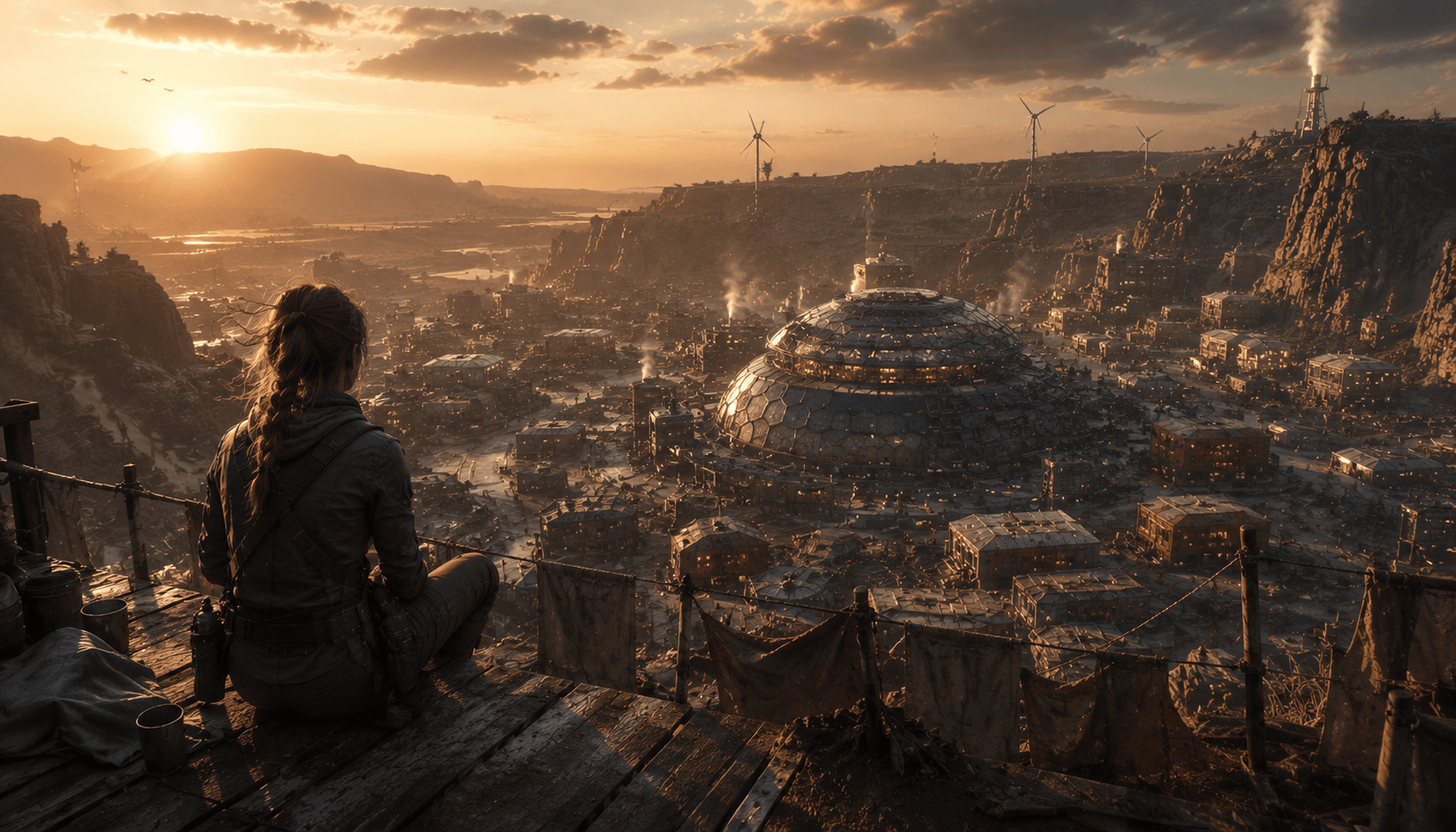
Veya and Trevor cut through the crowd without slowing. Trevor walked ahead, making it easier for her to get through if she could keep up in his long strides.
Workers drifted between the narrow walkways in stained coveralls, their shoulders dusted red from the mines. Cargo carts rattled along service lanes, hauling crates stamped with corporate insignias toward the loading yards. Above them all the transport towers blinked steadily against the dim sky.
From somewhere in the crowd, a girl called Trevor’s name. They both stopped and looked around. Trevor’s face broke into a grin. “I’ll catch up.”
Veya watched him go through the crowd and link hands with a girl she recognized worked on one of the other outer ranges. Smiling, she shook her head and continued walking. She knew where to go, Trevor had told her where they were setting up tonight on their way here.
She squeezed between two buildings and as soon as she made it through, took the spiral pathway down to the undergrounds. The noise shifted again as she reached the lower levels of the colony. The arguments and machinery gave way to something tighter, more contained. A crowd’s murmur. Excitement. Unease.
Veya recognized the sound before she saw the area.
A rusted service door stood half open between two storage blocks. Light spilled out from within, harsh and translucent white against the dark corridor. The smell reached her next—animal musk, blood, and disinfectant.
The ring.
She paused only a moment before stepping inside. The chamber had once been a cargo bay. Now makeshift steel barriers carved the space into a rough arena surrounded by narrow tiers of seating. Workers packed the stands shoulder to shoulder, their faces lit by the harsh floodlights overhead.
A hand closed around her arm, firm enough to stop her.
Sera stood at the edge of the entrance, half in shadow, a ledger in her grip that had nothing to do with animal feed. She looked at Veya the way she always did — like she’d already calculated three outcomes before Veya had finished walking through the door.
One eyebrow lifted. “You didn’t put your name on the fight card, didn’t expect to see you here tonight, recruit.” She said the last word mockingly. Sera had always looked down on the Expeditionary Corps. Something about grown adults prancing around in uniform to wrestle plants for corporate profit not being a thing to garner respect from the people who had real jobs. Like supplying animal feed, Veya surmised. And running underground fighting rings.
“I’m not here to compete tonight,” Veya said.
Sera’s expression didn’t change. “Scared already? Afraid to lose your coveted position as a new ARC recruit # 2007905?”
Veya shrugged her off. “Something like that. And that’s not my badge number. I’m #1.”
Sera smirked. “Keep dreaming, kid. It’s a good night to be scared. They have a Ferox.”
“I heard.”
They grinned at each other before Sera slipped back toward the entrance with ledger in hand, and Veya stepped further into the roaring crowd.
In the center of the ring, a man stood alone. Across from him, something paced behind a release gate. The crowd leaned forward as the handler pulled the lever. The gate creaked open.
A predator exploded into the arena.
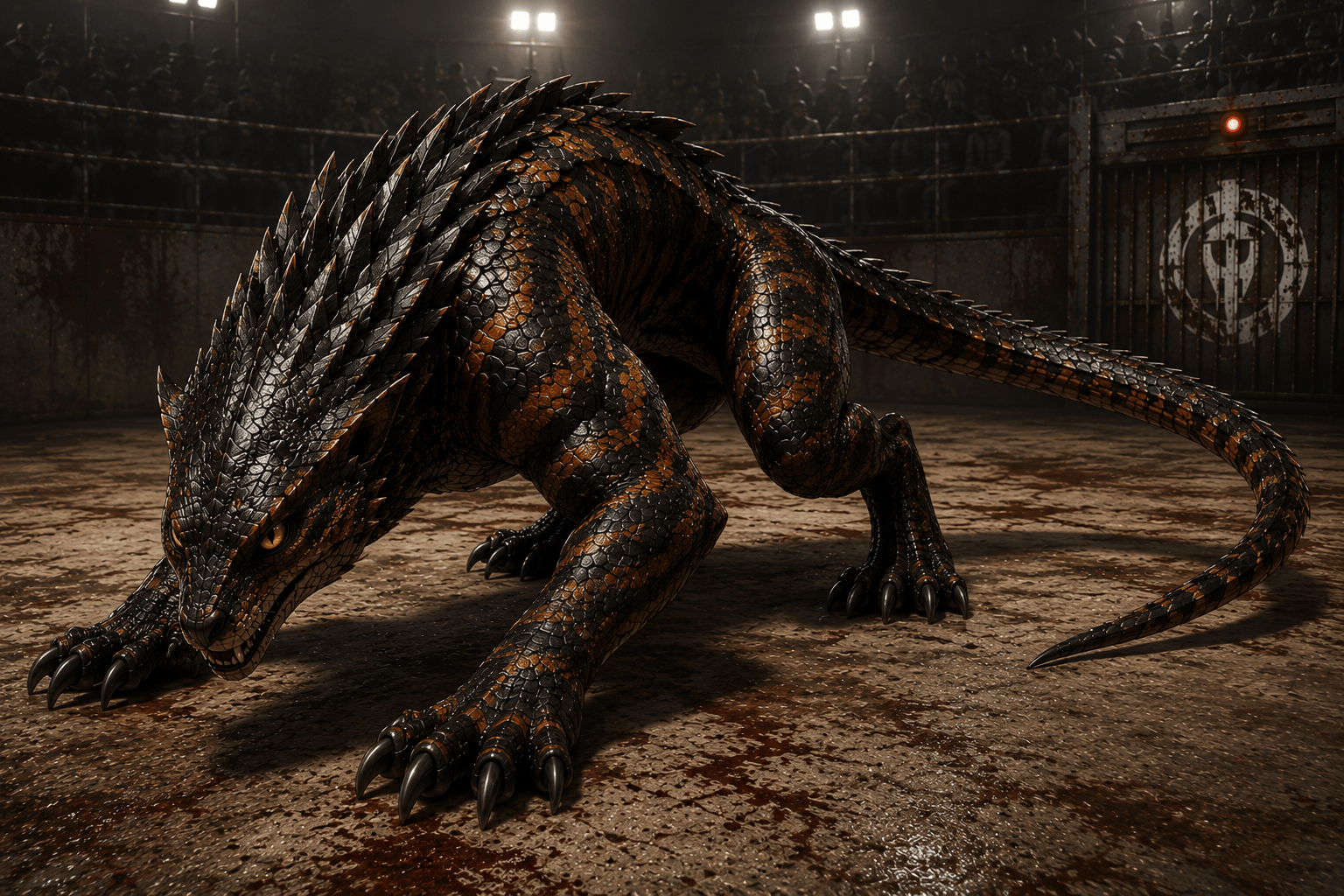
It landed low and silent, its body coiling like a striking whip. At first glance it looked almost feline—broad shoulders, powerful hind legs, a long balancing tail—but the resemblance ended there. Its hide was plated in overlapping scales, each one catching the arena lights with a dull metallic sheen. Stripes of deep amber and black ran along its body, following the ridges of muscle and armor.
Its head broad at the temples, tapering to a narrow jaw that hinged wider than any mammal’s could. Rows of serrated teeth flashed as it tasted the air. Two forward-facing eyes fixed on the man in the arena, pupils narrowing to slits as they adjusted to the floodlights.
Veya recognized it immediately. The researchers had catalogued it as Pantheradraco ferox—literally fierce dragon-panther. Expedition crews shortened it to Ferox. They were fast, territorial, and patient, preferring to toy with their prey and exhaust them or, if the opportunity presented itself, dealing a lethal blow as soon as a prey made the mistake of turning its back. Either to flee or simply a misstep. Which meant the man standing across the arena had already made his first mistake.
He kept turning to follow it.
To most of the crowd it was just another Biosphere predator, a recent addition to the colony’s holding pens. But Veya had spent months studying the field reports. She understood the underlying behavioral dynamic of what she was watching — the man trying to keep the animal in front of him, the Ferox methodically working to slip behind. It was only a matter of time.
Veya stayed near the back of the room, watching. She had seen battles like this before. Still, as she looked around, she found herself returning to the same thought: how they managed to get all this started and kept as an open secret, she’ll never know. Though people said it was reckless, even illegal, as far as Veya knew, no official laws had ever been written against it. Unfortunately, it was the closest thing the colony had to entertainment. And worse, to Veya, it had become the closest thing to learning how to survive on Thalyss.
Though she had no plans to participate tonight, she had heard rumors for months of a Ferox being added to the roster and she didn’t want to miss a chance of watching something so elusive in action. She was grateful Trevor had caught wind of it in time.
Seeing a major Thalyss predator in person — live and breathing — was something no restricted field report acquired through questionable means could replicate. Fragmented 3D visuals and scientific jargon written by people who rarely stood close enough to smell what they described only took you so far. This way, she might walk away with something real. Something that would help if she encountered one on Thalyss itself.
The man in the arena was slowing, his movements growing wider and less controlled, more sluggish. All the while the Ferox stalked him, its thirteen-foot tail swaying behind it with unnerving ease.
The fighter raised his weapon too late.
The scales along the Ferox’s spine lifted and fanned outward, catching the floodlights like rows of dark blades. Veya felt her shoulders tense. She recognized the posture instantly from the field recordings. A strike was charging.
The Ferox moved with terrifying speed, like tension finally snapping free. Its tail cracked through the air in a blur of muscle and scales as it landed on the man, burying its teeth into his shoulders and piercing armor straight into flesh. The crowd’s roar collapsed into screams.
Veya flinched, but made herself not look away. Anything she saw tonight could be useful later.
And if she was honest, part of her was glad the animal had earned itself a meal.
The handlers rushed forward once the animal had finished feeding, electric prods flashing blue in the floodlights as they drove it back toward the gate. The crowd thinned quickly after that. People always lost their appetite for spectacle once the reality set in. Veya remained where she was.
Workers dragged what remained of the man from the arena floor, leaving behind a streak of red and some pieces of intestine. The steel gate slammed shut behind the Ferox with a heavy clang.
Someone near the stands muttered, “They shouldn’t have brought that thing over here.”
Another voice answered, “There’s apparently worse than that on that Godforsaken planet.”
Veya watched the handlers secure the creature inside its transport cage. The scales along its back slowly settled, folding back into the smooth armored plates along its spine. Even contained, it looked powerful.
Vibrant and alive in a way the Redhaven never was.
A Biosphere creature.
The kind that lived on the world where Arden had died.
She turned before the cage was hauled away. The noise of the ring faded behind her as she stepped back into the corridor and took the stairs by two.
Outside, at a distance, the transport towers blinked steadily against the dimly lit horizon. Soon she would be there.
She turned from the sight and went deeper into the colony. Through another set of buildings and out into an expansive dirt path, past the sparse courtyard, through a set of green doors, down another set of stairs into a different section of the underground facilities. The lower corridors were bright, but the lights came from mismatched sources—old industrial lamps, portable heaters, the flicker of cooking fires in metal drums. Someone had dragged a radio into the walkway and music echoed between the concrete walls.
The deeper she went, the more the colony exhaled.
Day belonged to the mines, the cargo yards, the endless grind of contracts and quotas for regular citizens. For those on plantations and farmsteads like Veya, it was the constant upkeep of animals and machinery in order to keep the colony well fed.
The night belonged to the people.
Veya passed a cluster of workers crowded around a card table. Someone called out an offer to buy ration cards. A child ran past her chasing a metal hoop down the corridor.
She kept walking.
There was just one more stop she wanted to make before she headed to the cemetery. One last place that she had avoided for quite some time now, but craving the memories of his presence, and knowing this was her last chance to absorb them all, she headed deeper underground, towards the music and lights.
The bar was called The Sump, which told you everything you needed to know about it.
Low ceiling, low lighting, the permanent smell of machine grease and fermented grain that no amount of ventilation had ever successfully addressed. The stools were mismatched — three had been replaced after a fight four years ago and the new ones were slightly too tall, so half the regulars sat a head taller than the others. The back wall held a colony map so old that two of the outer ranges it marked no longer existed, swallowed back by the red-season shifts. Nobody had taken it down. At some point, it had just become decoration.
Veya pushed through the door and let the noise close around her.
Two-thirds full. The usual current of voices — maintenance workers still in their dust-caked gear, a table of rangers from the Edgehold stations she recognized by posture if not by name, a young couple near the window who had the slightly translucent look of people still in their first Redhaven year, not yet thickened by it. She’d had that look once. She could barely remember what it felt like to be that permeable.
She took what was once her usual seat whenever Arden managed to drag her in here, saying socializing was good for the soul even if it felt like torture. What was normal for everyone else he called character building for her. She could only take so much, so she would always commandeer the seat at the far end of the bar, back against the wall. That’s where Dara set a glass down before she’d even finished sitting.
“Heard you’re heading out,” Dara said.
Veya looked up. Dara had worked this bar longer than anyone could reliably say. Someone had mentioned once that she was the niece of the owner, but no one had ever seen the owner and so it was hard to verify. Dara was one of those people whose age had become impossible to track. Weathered, but beautiful. Warm, but shrewd. Oddly motherly for someone who tended to drunks all day—though in a way, that made sense, seeing as how she’d watched half the colony grow up from behind that counter. She had a way of knowing which glass to set down and chat over, and which to leave alone. Which is why Veya wasn’t surprised Dara didn’t bother asking why Veya hadn’t been around much.
“Word travels fast,” Veya said.
“Word here travels faster than the dust storms.” Dara leaned against the back counter, wiping a mug. “The ARC program? Arden’s Corp?”
Veya wrapped her hand around the glass and nodded.
Dara looked at her for a moment — the particular look of someone who’d heard enough careful non-answers to recognize the outline of a real one — and then let it go. She moved down the bar to refill someone else’s glass, and Veya exhaled slowly and took a drink.
She was already starting to question why she’d come here. A need to be where Arden once was, but never will be again? A need to be in a room full of people she half-knew before she went to a place where she knew no one? What did she think she would accomplish coming to a place where she normally didn’t even like being, surrounded by memories of her lost brother, preparing herself to go to the same place where he was lost, the same place she might never come back from, just like him? She gripped her glass tighter in an attempt to feel some semblance of control.
She’d lived her whole life in the colony’s margins — close enough to come in when she needed to, far enough out that the homestead never quite felt like it was inside anything. The Sump was the middle ground. The place where those two versions of her life occasionally agreed to exist in the same room, forced upon her by Arden. At time, thankfully . It allowed her another place to get lost in. But not today. Today the noise felt heavier than usual.
She became aware of the conversation behind her before she’d consciously started listening.
Two men, she thought, and a woman. Their voices were lowered, but in that small space, still carried.
— that’s the Damaris girl, yeah, she’s in ARC now —
— Arden’s sister —
— always figured she’d end up somewhere like that, with the way she handles the outer ranges, she was the one who held the line and secured that Varak two months back. The kid barely panicked at all —
She kept her eyes on her glass.
— but ARC’s a different thing entirely, that’s not range work —
— well, Arden did it —
A pause. The particular weighted pause of people remembering something they’d rather not say directly.
— yeah, and look how that went.
Silence at the table. Then the conversation shifted, moved on to something else, the way conversations did when they’d briefly touched something true and flinched away from it.
Veya took another sip and set the glass back down carefully. She was doing the thing she’d learned to do — staying very still and waiting for the tightness in her chest to either dissolve or become manageable. It usually became manageable. That was the most she’d learned to hope for.
She didn’t know what had happened to Arden exactly. Not really, not in the way that would let her stop asking. The colony’s official position was that ARC expeditions to Thalyss carried a high attrition rate and that personnel outcomes were confidential for reasons of operational security, which was the kind of language that told you everything and nothing simultaneously. She’d filed three information requests. She’d had two conversations with ARC liaisons who’d looked at her with the specific practiced sympathy of people trained to give it.
She found herself thumbing the etching on the necklace again.
Dara set down a bottle, startling her. Now when Dara looked at Veya, the look was different from her usual — something more deliberate, something that had been decided on before she’d spoken. As if she was aware of the thoughts circling Veya’s mind.
“Arden used to sit in that exact seat, you know. Before he shipped out. Last three nights he was here, same spot.”
Veya was quiet for a moment. This was her spot. “I didn’t know that.”
“You weren’t here those nights.” She said, matter-of-fact. “He talked about you, a lot.”
“That can’t have been very entertaining.”
One corner of Dara’s mouth lifted. “He was proud of you.”
Veya looked up at her. “I haven’t done anything.”
“He said you noticed things other rangers missed.” Dara shrugged. “Tracks. Behavior. Fence weaknesses. Sick animals before they turned aggressive. Details. Practical things.”
Veya looked down at the glass in her hands. That sounded more like Arden’s training at work.
“You know, he knew ARC would eventually come back for you,” Dara added.
Veya’s eyes flickered up.
“He wasn’t happy about it,” Dara continued, wiping down the counter again. “Though he certainly didn’t expect you to volunteer, after all that he did to keep you off the list.”
Veya didn’t respond, her jaw tightening slightly.
Dara’s eyes shone gently at Veya’s tense expression and she leaned her elbows down on the counter so she could meet Veya’s downcast eyes. “He knew what you were capable of, even back then, Veya. ‘You’ll see,’ he had said. I’ve seen many kids come and go from that program, and some just never came back. I hadn’t expected Arden to be one of them. Just like I don’t expect you to be either. But I, for one, Veya, did know you would volunteer. ”
Veya felt Dara’s hand squeeze her forearm briefly before she disappeared to serve new customers on the other end of the room.
Veya stayed for another half hour. Let the room move around her — the noise and the warmth of it, the accumulated weight of people who worked hard in a difficult place and had made their rough peace with it. She’d grown up in this sound. She would miss it in the way she missed things she didn’t have words for.
When she stood to leave, Dara caught her eye from the other end of the bar and nodded once. Veya nodded back and walked toward the exit. She pushed through the door and out into the night.
The cold air hit her like a hand against the chest.
She stood outside The Sump for a moment, not moving, while the red dust dark settled around her and the moons made their way up above the ridge. She started walking.
He was somewhere she couldn’t reach him. He had gone to a place she was only now being allowed to go to, and she didn’t know what had happened there. She didn’t know what she was going to find. She didn’t know if the version of finding she was hoping for was the version that waited for her at those coordinates.
The pendant pressed against her skin with each step — small, certain, its weight already belonging there. She kept walking, out of the colony lights and into the quiet road toward the graveyard.
The cemetery sat on the edge of the colony where the air recyclers hummed loud enough to drown out conversation. Rows of metal markers rose from the dusty red ground, each stamped with a name and date. Most of them were small. Many were recent.
She had been here enough times to know the path without looking — past the newer markers near the entrance where the ground was still dark and undisturbed, deeper toward the older rows where the red dust had reclaimed everything and the names were harder to read. She stopped halfway down and crouched.
ARDEN DAMARIS
She stayed low for a moment, just looking at it. The marker was the same as all the others. Same dimensions, same stamped lettering. There was nothing that distinguished it as his except the name, and sometimes even that felt wrong — reduced, somehow. As if whoever had made it hadn’t understood what they were labeling.
No body lay beneath that marker. Still, she placed her hand lightly on the barren ground and brought it back to her heart. The official report had been short. Predator attack. Remains unrecoverable. The kind of explanation expeditionary corporations issued when there was nothing left to send home except a person’s belongings.
The wind moved through the rows of markers and stirred the dust around her boots. Somewhere behind her, two workers were arguing about supply rations, their voices carrying across the open ground. The colony was always loud in small ways like that. It didn’t know how to be quiet, even here.
On the horizon the atmospheric processors had begun their nightly cycle, their bulk just visible against the dark skyline. A moment later the mist came — low and slow, bioluminescent, drifting in from the colony’s edge the way it did every night now. It settled between the markers in pale drifts, catching the moonlight.
The scientists had found the organism on Thalyss — something that grew in the deep forest floors and scrubbed toxins from the air the way moss cleaned water. The corporations had been quick to replicate it. Veya could remember when the purifying masks were just part of dressing in the morning. Before the organisms arrived on the planet.
Initially it was an odd experience. Both eerie and beautiful, the only splash of color on the red planet. Especially vibrant if you ran through the shadows between buildings. It was there that they glowed the brightest, hidden from the soft light of the double moons.
Most of the younger children in the colony had never needed to wear the purifiers. They had grown up breathing air that Thalyss had made clean.
Some of the mist made its way to where she was and landed on the edges of the marker, its glow gently pulsing as if it were breathing. Perhaps it was. She stared at the metal plate for a long time before speaking.
“I wish you hadn’t gone.”
The anger in her voice sounded strange in the open air—less contained than it felt inside her chest, where she had learned to push it down and keep it small. Spoken out loud, it sounded like it felt. Large and painful. Expansive. Uncontrollable.
She stood. “I know you did it so they wouldn’t take me. But you didn’t have to always be such a hero.” She spat the last word, starting to feel her vision blur and her breath catch. She took several steadying breaths before continuing. It was only here that she felt free to say what was on her mind. “Didn’t you stop to think that maybe I needed you here, alive and breathing? That I wouldn’t be strong enough to bear this? That maybe I should’ve been the one to go this time? That would’ve been the right choice. You would’ve had a great life. Instead you left me here. For what? To do what? To live like this?”
The words hung there, the wind gave no answer.
She tipped her head back, letting the cold air fill her lungs. Above her the sky never quite darkened — it just thinned, the way it always did, a pale wash of light from the two moons that made everything look like a dimmer version of the day.
Across the valley, the large transport towers rose against the horizon, thin silhouettes blinking steadily. Ships came and went every week from those towers, carrying personnel and shipments of resources to and from the massive corporate vessels overhead. The ones that monitored and extracted from Thalyss.
And sometimes nothing came back.
“I know you didn’t want me to go,” she said to the skies this time, “I know you did this so I wouldn’t be taken.”
The pendant pressed warm against her sternum now, no longer cold the way it had been when she first fastened it this morning. She lowered her head and spoke her next words to the empty plot of land in front her.
“I’m going anyway because you shouldn’t have left,” she said quietly.
She didn’t wait for the wind to answer. She turned and began the walk back toward the colony lights.
![Book Summary: The Devil and the Dark Water [FULL SPOILERS]](https://gwuwi.com/wp-content/uploads/2026/10/The-Devil-and-the-Dark-Waters.png)





Leave a Reply